Posts

Art Therapy- I tried it and you should too! By: Lauren Avila

Art therapy can come in many forms through hands-on experience and engaging creativity, be that through performance or fine arts. There are individual and group sessions of art therapy widely available throughout London. It is a practice that is led by a trained professional with the intention to offer a safe environment to get in touch with feelings that may otherwise remain guarded. There is evidence to support that engaging in art therapy helps individuals to speak more freely and become more relaxed when facing an issue. 

Each individual is different and each person’s needs vary. Some people may need the guidance and healing that comes from a trained art therapist. However, that does not discount that art, in its many forms, is therapeutic on its own. 

The British Association of Art Therapists state on their website that “art therapy can help people of all ages and at all stages of life, including those whose life has been affected by difficult personal or cultural experiences, illness and/or disability. You do not need to be skilled in art to benefit from art therapy.”

That was the case when I put this theory to the test. I observed and participated in different types of art with groups of normal people from different backgrounds. 
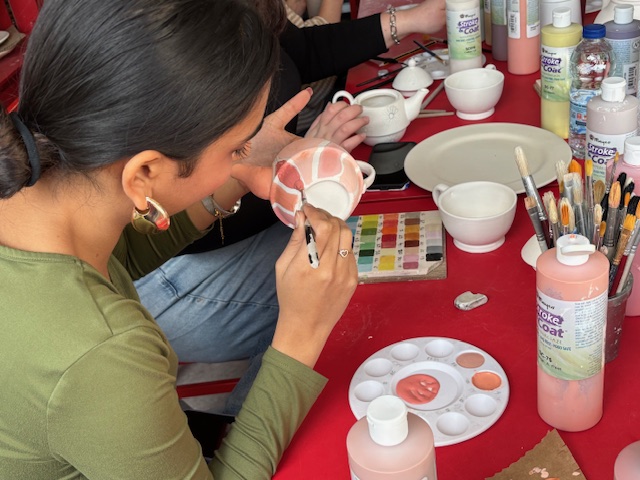
 

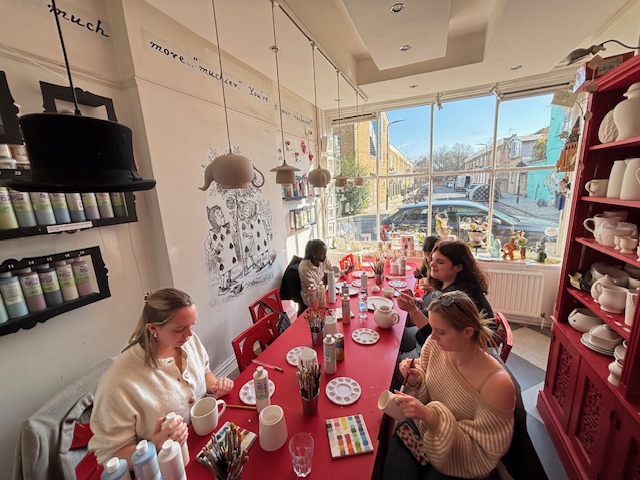
First I went to Wonderland Ceramics to test if fine art really can help people with their mental health. The task? Choose a ceramic item and paint it in any way one wishes to. It turns out that art as therapy really is dependent from person to person. In a group of seven, a couple attendees felt stressed by this task. They found it difficult to choose an item, then choose how to decorate it, and also to efficiently do so. 

“I feel stressed because I’m a perfectionist, but I also feel relaxed because I know I can take my time,” Leyonce explained when asked how creating art made her feel.

Others found these steps less intimidating.

“I love this,” Skye said. “I’m so glad I decided to do this.”

Despite the rocky start, over the course of time the challenge became easier and the room’s temperament changed. People felt more at ease and the conversation in this group became more comfortable by each passing minute. As mentioned earlier, evidence supports that art can encourage a person to open up and share deeper thoughts and feelings.

“I was feeling stressed but I’m feeling a lot more relaxed now,” Gilly shared.

I challenged the theory again when attending a performing art event. The task? Have beginner and intermediate dancers try to teach and learn from each other. As an overall observation, this much larger group of about twenty attendees followed a similar pattern. About half the room was filled with timid beginners but by the end of the event there was a buoyancy in the room. Everyone’s spirits were lifted and the whole group bonded in conversation long after the event concluded. 

Speaking from personal experience from both activities, I felt relaxed, jubilant, care-free, and fulfilled while participating and immediately following each event. I can also say the same from other art forms such as writing stories and taking pictures. Again, this is different for each person but I believe it is safe to say that art as therapy is worth looking into. 

To find out more about the evidence behind art therapy, how it works, what types of therapy there are, and where to start looking for an art therapist, visit Mind. If you are local, consider looking up the classes and events that are offered here at Paddington Arts. 


Van Gogh: The Immersive Experience By: Lauren Avila

Likely if a person mentions the name of the famous Dutch artist, Vincent Van Gogh, it immediately prompts images of deep hues of swirling skies or bright yellow flowers resting in a vase. Van Gogh: The Immersive Experience, which has been open since 2021, is elevating old classics and converting them into  new forms for anyone to enjoy. 

Upon entering the exhibit and throughout the layout of rooms there is an abundance of information about Van Gogh. As much as it is a welcome change to approach well-known art in a new way, it is vital to first understand the artist. The exhibit includes various ways to get to meet Vincent, the man. There is a comprehensive history provided pertaining to his birth, family, physical and mental challenges, and the end of his life. Of high interest to those who may not know about Van Gogh’s style, this information also includes the reason why he created art the way he did. 

Beyond learning about the art is the art itself in various forms. The exhibit introduces large scale versions of some of Van Gogh’s most notable works. What was previously only known to the world through oil paintings is brought to life by set pieces, backdrops, and computer animations. 

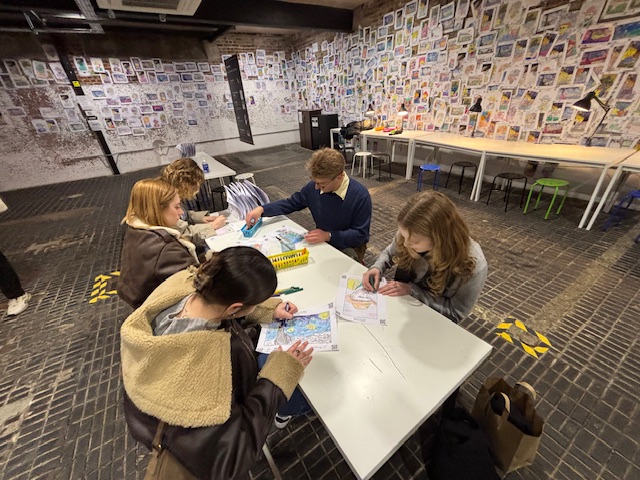
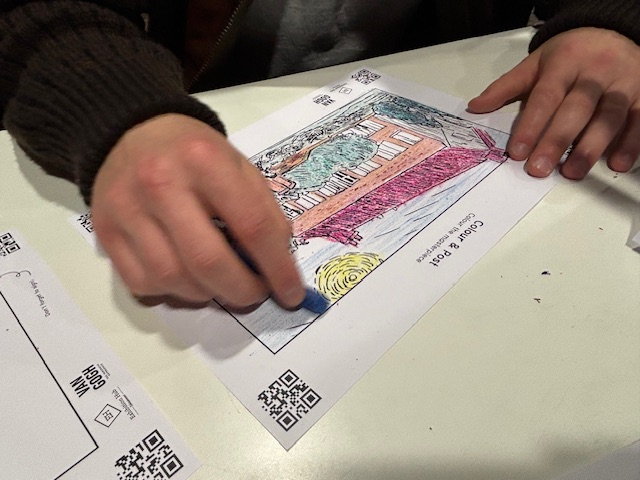
Additionally, visitors are given the opportunity to be hands-on and fully immersed as the name of the exhibit implies. There is an entire room full of art from past visitors who paid homage to Van Gogh’s most well known paintings, such as “Starry Night,” “Self Portrait,” and the “Sunflowers” series by creating their own version of it. The Immersive Experience also offers a VR experience (that comes at additional cost) to see the paintings up close in a digitally-advanced environment.

“I really liked that the whole point of the immersive experience is to see his life from his point of view,” Van Gogh the Immersive Experience visitor, Udeshna, observed. “I like that the asylum and The Bedroom paintings were immersive and that it gave a brief of his life.”

Throughout the exhibit there are ways to observe the man, the paintings, and also a way to engage with them. Still, it is the conclusion that truly brings the visitor into the art. Visitors step into a room that is covered in screens from floor to ceiling and creates a 360 degree world of art. It is flooded with lights, music, and moving projections. Chairs, benches, and loungers provide a welcoming environment to relax and submerge completely into the art that was only looked upon moments before but now surround the visitor in an all-consuming way. After learning about Vincent and his trade, it is more emotional to feel a real and deep connection to his art, including quotes from him. 

One may experience a new sense of appreciation of a man’s life work when surrounded by his art and reading his own words: “Success is sometimes the outcome of a whole string of failures.”

Van Gogh: The Immersive Experience is self-guided so a person may enjoy it at their own pace. The exhibit provides several rooms of information, art, and photo opportunities, therefore it is easy to let hours slip by, particularly in the final room. It can be enjoyed for a few minutes or much longer, with footage looping every ten minutes or so. 

Tickets for the exhibit begin at £20.90. It is currently an ongoing experience.

Discovering Ireland in the Heart of London By: Lauren Avila

On Sunday, 16th March, London’s Trafalgar Square was host for the St. Patrick’s Day Festival & Parade, celebrating Irish culture with thousands of locals and tourists. It was a feast for the senses with the colors, music, food, drink, and Irish lore everywhere. The event kicked off with a parade from Hyde Park, along Piccadilly Circus, Trafalgar Square and concluded at Whitehall. Attendees came out in droves and in high spirits, adopting the Irish culture, even if only for the day, regardless of their origin. There was a sense of joy and pride illuminating the streets as everyone cheered alongside the parade.. The cavalcade, shining in hues of green and gold, included floats, musicians, singers, dancers, runners, costumed performers, and representatives of charities. Each group celebrated and recognized contributions of the Irish community, whether locally or internationally. Along the route, parade viewers could spot the Council of Irish County Association of London, a children’s Irish marching band, the Irish London Running Club, ASM Recycling and SISK Contractors, a company established in Cork, Ireland. 
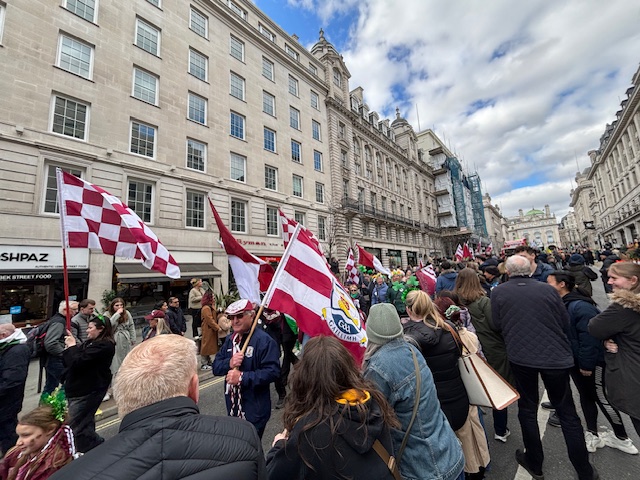
In the midst of the Square was an abundance of Irish arts and culture. At the main stage was an ongoing presentation of Irish talent, from traditional Irish dance to a ceilidh band to singers. Surrounding the stage was a culmination of more Irish cultural immersion. Vendors for merchandise, food, Ireland tourism, and local Irish groups in London. There was also a beautiful art exhibit, called “Peace Heroines,” which recognized some of Ireland’s most accomplished female contemporaries working towards peace, including Bronagh Hinds, Susan McRory, Pat Hume, Eileen Weir, Saidie Patterson, Anne Carr, Monice McWilliams, Pearl Sagar, and Baroness May Blood. 

Behind the food stalls were some of the best booths, including a booth to learn the dances, try some Irish crafts, and be introduced to Irish creators and their work. This last booth mentioned was presented by the Irish Creative Collective, an organization which showcases Irish talent from musicians to comedians to filmmakers. In this booth, there was an entire schedule of events for Irish creative arts to be shared with the public. These events were intended to educate, entertain, and inform about Ireland and their heritage. Among the creatives was a storyteller who also presented an introduction to the Irish language with words and phrases, such as “my name is…” 

There was also a screening of three short films made by Irish filmmakers. They were called “Boogaloo and Graham,” “Color Me Pink,” and “Dear Imelda.” Each film was made in Ireland and not only had a touching story, but wonderful visuals to enjoy. Fortunately they are all available to watch online. Catch “Boogaloo and Graham” on Disney+, “Color Me Pink” on YouTube, and “Dear Imelda” on the Samansa app. 

From every corner of the arts and culture world, it was thrilling to see that the arts are alive and well in Ireland! How wonderful that Irish natives came to share their talents and introduce their culture in a beautiful and warm way. 

“Alterations” at the National Theatre By: Lauren Avila

Every choice just like any alteration in a person’s life can change it. To cut and hem time may cause a person to lose those which they love. Sew together the bonds that matter and a person can create a high quality product. Deciding which pattern to follow is the choice one must make, particularly when it comes down to an ultimatum. This is the emotional scale that is explored in the National Theatre’s current production of “Alterations.”

Soft, Caribbean melodies play in the background as patrons take their seats well before showtime. The sounds of traffic and bustling city life accompany it to create the atmosphere of the forthcoming story. Sirens whirring, cars honking, engines revving, and squealing wheels put the play in motion before it’s even begun.

The set, designed by Frankie Bradshaw, is singular, sitting upon a rotating platform. It is a tailor shop with a wall of clothing hanging about in the back. A few work tables fill the elevated, square stage. Every table provides a space to cut, sew, and repeat. A plush, burnt orange-colored chair sits in the corner, inviting any tired worker who is in need of the occasional tea break.

A full three minutes before showtime a man appears on stage, dressed in flare jeans, a paisley-patterned top (unbuttoned midway) and vintage brown leather jacket. He’s sporting aviator sunglasses and holding on top of his shoulders a retro radio. A cyclist circles the neighborhood as shoppers and others go about their business. They are not bothered and are simply enjoying their daily life. 

Seamlessly the play begins…

Above the street, in a small tailor shop, Walker (Arinze Kene) is embarking on a timely task that will define his future. He has just accepted a commission for a large amount of trouser alterations. Mr. Nat (Colin Mace), a German immigrant, allows him the opportunity to do the task in a potentially life-changing deal. If Walker can fulfill the order in time, he will receive enough money to buy a tailor shop on Carnaby Street.

“Alterations,” directed for this adaptation by Lynette Linton, unfolds over the course of 24 hours, with each minute rising with intensity. 

While Walker is working in the present he cannot stop thinking of the past and the future. His story is what stitches together the gap between the two. Not only is there a pressure to complete the challenge ahead of him, there is a dream at stake that consumes every part of his life. Still he allows himself to get distracted over and over in vignettes of his life, illuminated by Oliver Fenwick’s design.

Time plays a major role in “Alterations.” There is use of light and music to pass time, to create atmosphere, and to get into Walker’s headspace. Music is well-integrated into this production with help from sound designer, George Dennis, and composer, XANA. From the sounds of reggae or blues, to the bursts of music that shifts the mood of time-lapsing scenes.  

In the shop, Walker relies on Buster (Gershwyn Eustache Junior) and Courtney (Raphel Famotibe). For this task he also employs another friend, Horace (Karl Collins). While all the characters in this production are suitably dressed for the 1970’s era of the play, none are as beautifully, albeit ostentatiously, dressed as Horace. Amongst his array of fashion choices is a purple, perfectly tailored suit by costume designer, Frankie Bradshaw.

Buster is a reliable business partner. He stays on task and avoids drama, regardless of the fact that his wife is in active labor throughout the play. He is waiting, much like Walker, for a new life to start. Courtney is a young local worker. He is ready to work and make his way up in the world. Horace is ambitious but keeps the balance between aspirations and priorities.

Darlene (Cherrelle Skeete) is Walker’s wife. They have come to London from Guyana, pursuing their individual dreams. Darlene is facing challenges of her own, having recently been fired. She needs support, both financially and emotionally, from Walker but he tends to come up short. He struggles to stay present as he chases his dream. As the play progresses, Darlene’s problems motivate the changes and decisions she feels she must make in order to achieve the dream she has formed for herself and her daughter.

Walker maintains distance. The dream is what matters. Friends and family are secondary to him. However, life is full of hard lessons that have to be learned. The play focuses on the price that comes with success. 

Regardless of the profound themes of self-fulfillment and happiness, there is still a laugh to be had. Abbensetts’ play, with additional material from Trish Cooke, provides plenty of levity. The audience that sat in on a preview performance picked up every bit of humor sewn into the performance. 

The production value is simple and avoids being overly flamboyant, neither visually or in sounds. There is just barely enough movement to keep the average audience member’s attention for the nearly two hour running time (without an interval). Unfortunately, one of the most engaging set and costume sequences comes down to only minutes. Additional platforms, costumes, music, and performers come together for a dream sequence that is as fleeting as a  fashion trend. 

Walker continues to want more throughout the play. More love. More business. More space. He wants more and is willing to live with less to have it. It would seem the National Theatre followed a similar pattern. There seemed to be a goal to add more to the retelling yet the creatives collaborated together to present less. If you prefer the less is more route and if you enjoy a straight-forward underdog story, go to see “Alterations” at the National Theatre. The show began previews 20 Feb, opened 27 Feb, and will play through 5 April.


Exploring London’s Magical Christmas Markets

By Sami Mahfood

London’s Christmas markets are a must-visit during the holiday season, turning the city into a festive hotspot. From the massive Winter Wonderland in Hyde Park to the amazing lights and live entertainment at Covent Garden, each Christmas market brings something new to the table. Here are my reviews of some of London’s most magical Christmas Markets. 


Winter wonderland 

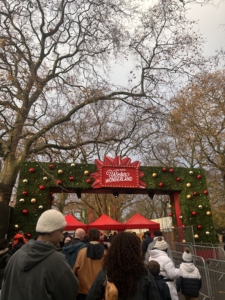
The Christmas event that London is most famous for would be Winter Wonderland. Winter Wonderland in Hyde Park is a must-visit during the holidays and offers way more than just a Christmas market. It is a combination of christmas markets, food halls, arcades, and an amusement park. There’s something for everyone, from shopping for handcrafted gifts, enjoying festive treats, over the top roller coaster rides, an enormous ice rink, and even themed bars like the Carousel Bar. There are also various entertainment options including live music, circus shows, and the incredible Magical Ice Kingdom. It’s perfect for a fun day out with friends or family, or even as a festive date spot. It starts to get more crowded and chilly later on in the day so I suggest going in the early afternoon. I went around 2pm with a group of friends and it was the perfect time to go! The entry tickets were 5 pounds, it was the perfect temperature, and not too busy. Although the food and games can be a bit pricey, its definitely a fun activity for all and something everyone should experience at least once while visiting London!

Covent Garden 

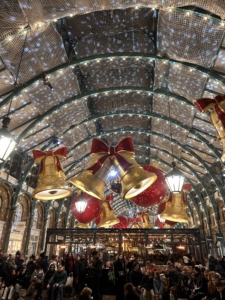
Covent Garden’s Christmas Market is the perfect mix of holiday magic and upscale charm. Famous for its dazzling Christmas lights and giant centerpiece tree, the market offers a cozy yet lively atmosphere. While it’s not a traditional sprawling market with rows of wooden stalls, Covent Garden features pop-up shops and boutiques alongside its permanent stores, offering a range of unique gifts, artisan goods, and luxury items. Live performances, including carol singers and occasional street entertainment, add to the festive vibe. It’s a great spot for an evening visit, especially if you’re into shopping and soaking up the holiday atmosphere. However, it can get quite crowded on weekends, so make sure to plan accordingly. Covent Garden Market also directly connects to the Jubilee Christmas market which has more pop-up stores continuing to offer a wide range of potential Christmas gifts. Surrounded by restaurants with seasonal food and drink and an arcade of various stores, Covent market might be my pick for number one Christmas market in London 2024. 


Leicester Square 

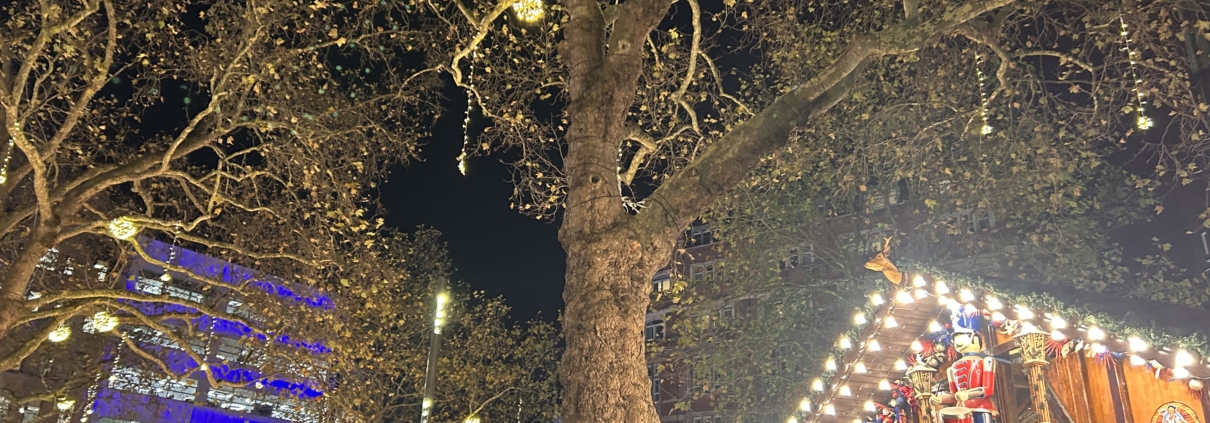
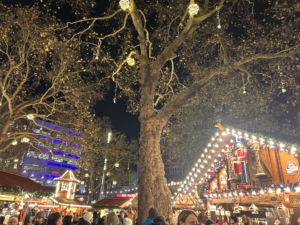
Leicester Square Christmas Market is a cozy festive spot right in the heart of London’s West End. Though it is a smaller market, it has charming wooden chalets with hand crafted gifts, ornaments, and seasonal treats. The highlight of this market is the location. You can walk through and grab a bite of festive food before you see a West End show or after your day of shopping. The gorgeous glow from Christmas Lights and the big screens illuminates the market making it a shining light in the center of London. This market also has Santa’s Grotto which young kids and families can enjoy. A statue of Mr. Bean on his bench is at the entrance of this market which adds a unique touch of British culture to this already very British tradition of Christmas markets. While it can get crowded because of the location and size, its intimate vibe and great entertainment make it worth a visit.

The Art of the Interview: My Experience Interviewing Artist Carl Gabriel

By George Clyde

As part of my internship experience with Paddington Arts, I got a chance to interview local artist, Carl Gabriel. Carl immigrated from Trinidad to London when he was around 8 years old. He attended university for engineering, before changing paths and using his technical abilities to become an expert wire-bending sculptor and a prominent figure in the carnival arts scene.

When I began to prepare for the interview, I decided that I wanted to shift the focus away from the actual technicalities of his art, which his past interviews online had centered around, and tell his story as a person. Through his own personal journey, I hoped to find something deeper about immigration or activism in the arts or access some new perspective about the ideas and people that make carnival what it is. 

When I started off the interview though, Carl immediately pushed me away from touching on his life story. “Let’s keep it to carnival,” he said. Attempting to switch my focus up on the spot, what I came away with was an interesting interview, with some good insights and brief personal moments, but it was scattered and it lacked a center. My takeaway, as I continue to learn and grow as a journalist, is that rather than forcing the interview away from his identity as an artist, I should have explored him through that route.

An interview is always a push and pull between the interviewer and interviewee in terms of which direction it takes, and I don’t think I quite got that balance right. Moving him away from the technicalities may have been a good move, but I feel that I moved him away from his art as a whole. By asking him about what the different pieces meant to him and getting him to tell those stories, I may have gleaned something of his relationship with his art and the ideas and beliefs that drive him as a person both in his art and outside of it. It didn’t help that the second part of the interview, where he took me around and did begin to talk about some of his individual pieces, was cut off by the camera running out of storage. I also wish that I got some stories about his time working with the other carnival pioneers. I think that would have shed some more light on what the experience of carnival was like from the inside. 

What I did really like about the interview was that you got the sense of his strong attachment to wire-bending as an art form and his commitment to authentically representing West Indian art and culture. He talked about his introduction to engineering back in Trinidad, which contrasted well with the end of the interview where he discussed how he’s now committed to passing on the skills and traditions to the younger generation. “I want them to know that there’s an outlet for them to represent our culture,” he said. “If they do it right, there’s opportunity there.” Even if the interview wasn’t as focused as I would have liked it to be, I do feel that it gives a good sense of Carl’s demeanor and personality. As a personal experience, I very much enjoyed getting a chance to enter Carl’s space and have a conversation with him about his journey into the arts. In the process, I’ve learned some valuable filmography, editing, and interview skills that I’ll certainly take with me into the future.

My Time at Paddington Arts

By Carissa Leong, intern

After seven weeks, my time as an intern in the Digital Newsroom is finally coming to an end. During my time, I’ve appreciated the opportunity to get to know more about the local area while also engaging in media that I enjoy, whether it be about films or music.

My time at the company started off strongly with my analysis and review of Dune: Part Two, a film and franchise sequel that I loved. Surely excessive in length, I enjoyed breaking it down thematically and comparing it to the book, and it was one of my favorite projects that I engaged with.

Another cool experience was the opportunity to work with artist managers from UROK Management, Laura Leon and Annabelle Scott-Curry, to cover Tom Odell’s show at the Roundhouse. Having gone in knowing so little about his work, I ended the night discovering an incredible artist with completely warranted popularity. His vocals, instrument composition, and minimalist aesthetic were all so well put-together and immensely impressive to witness live.

Following that up, I compiled a list of publications for send-outs and drafted a press release for Steve Shaw’s photo exhibition, aided by the social media manager Karina Saniuk. I also had the opportunity to develop my interview skills by asking her questions about her career in social media marketing and as a freelancer. On top of all that, I was able to create my own graphic through Canva promoting the upcoming Slam Dunk 2024 rock music festival with a brief playlist of recommendations. 

I got to wrap up my time at Paddington Arts with reviews of a few more recent releases that I enjoyed. One of them was English director Alex Garland’s Civil War which was a dystopic take on America that lent commentary on the role of war journalists. Meanwhile, the other was Fallout, an Amazon Prime Video television adaptation of the popular post-apocalyptic video game series. I finished it in two days, loving the black humor and retro aesthetic clashing with dystopia, and I really appreciated that I was able to share my thoughts on it.

Something that I wish I’d been able to do while I was here was pursue marketing and PR more, as I had gotten the option and assignments late into the term. I would’ve loved to have more time to practice my skills with videography and editing, but I am at least grateful that I got practice with PR and press releases. While I will end up utilizing some skills from journalism in the future, it ultimately is not of interest to me for a career, and I would’ve loved to have the alternative option of marketing earlier. Music photojournalism will always be what I can do on the side, but music marketing–whether it be with a record label or concert promoter–is my end goal which I didn’t get to develop skills specifically for. 

Ultimately, I had a good experience at Paddington Arts and I greatly appreciate the team for giving me free reign to engage in my interests and share it with the world. It supplemented my already existing content creation and journalism experience, and I believe growth from this internship will help me shift career directions in the future.

My Internship at Paddington Arts

As my internship at Paddington Arts comes to a close, I’ve been reflecting on the last four months that I’ve spent in London. I’ve been studying abroad here through a program that works with my home institution in the US. The first half of the semester I spent focused solely on courses, and in this latter half I have continued two courses along with adding an internship. Because we are placed in our internships, students don’t get to know ahead of time where they’ll be interning or what their tasks might entail. I’m currently studying English with a concentration in Creative Writing (my major), and I’m minoring in Book Arts and Art Studio. Ultimately, my goal is to be an author of creative works. I’d also love to work in the book publishing industry, potentially as an editor or designer. 

When I was placed at Paddington Arts, I was unsure how my skills and goals would fit with the internship. Our program told us to be openminded to new experiences, and that’s the mindset I took on. When Steve, the director at Paddington Arts and our internship supervisor, told me and the other two interns about his online magazine project, I was happy to help. I enjoy writing, which is what much of my internship has revolved around. Our internships are focused on journalism, which is something I don’t have much experience in. It has been a bit tricky to navigate this different kind of writing style along with the idea of interviews. 

I’ve enjoyed writing every week, because I think writing must be a regular practice if I am to get better at it. Since I haven’t had a lot of time to write on my own time while being in London, it’s been nice to go to my internship and do so. I liked getting to know the local area as well. Though my internship experience has been relatively short compared to one I had last fall in the US, I’m pleased to have practiced my writing skills and to have learned a bit about the community here where Paddington Arts is. 

American Student on Living in London

I met up with Em (pronouns: she/they) at Europe’s largest bookstore. We went to the Waterstones Piccadilly café, where Em ordered a matcha and I ordered chai. 

Once we sit down with our drinks, Em smiles pleasantly at me, anticipating the questions I have for her. We’re both American students who have studied abroad in London for the past four months, and I want to get their full take on the experience. 

We both sip our warm drinks, commenting on how good they are. Em takes in the design of the café with its warm wood and lively plants, and she looks relaxed in her whimsical dinosaur sweater. I feel a sense of calm, too—bookstore cafes do that to me. 

I start at the beginning, wanting to know why Em chose to come to London in particular. There are many study abroad program offerings, what made this one stand out? 

Em tells me that they had actually considered transferring to a London school after their first year in college. She always wanted to study in London, so why not? Her mom had different thoughts, though, and ultimately Em decided to stay where she was. Plus, she would still have the opportunity to study in London for a semester, which seemed like a good alternative. And anyway, the required internship as part of the program was appealing to her. 

I ask Em about their internship. She actually has had a very good experience, which she seems to be surprised by. She works on customer visitor experience for a museum but said she “would rather be in curation.” Even so, Em enjoys their days at the Courtauld. The people there, she explains, are more comforting than most of the people she attends class with. 

Working where she does, Em has found that people can be casual about spending extraordinary amounts of money. She connects this to other study abroad students, who come from wealthy homes and aren’t aware of their privileges. “Sometimes, people don’t bat an eye that the print for sale is, like, 2,200 pounds. Which is a lot of money for a piece of paper, in my opinion.” 

Em knows that their coworkers feel the same way. “It’s wild that people can essentially throw money at something, and I’m not being paid, all of us are just working and watching people do that.” She continues, saying of the museum’s guests that, “Also, it’s wild they don’t view you as a person, they view you as a problem-solver. No, I cannot fix the fact that [the museum is] five floors.” It’s hard for her to keep these thoughts to herself when there are ridiculous complaints aimed her way. “I’m like… I can’t fix that.”

Em enjoyed spending time seeing some Shakespearian plays for one of her courses. However, she found herself people-watching on some occasions. She recalls to me that for her class viewing of Othello, she noticed how many attendants were white and upper class. The type, she theorizes, that go to the theatre just to say they went. 

Em loves to talk—she tells me so, that small talk is her strength—and we skip around from topic to topic. When asked about what they’re taking back to the US with them, they pause. She says she’ll be taking back a lot—things she wouldn’t have access to back in the states. She lists off books, figurines, K-pop stuff, even plushies. Though she has many physical items she’s taking back, she also brings up the incredible friendships she’s made that will outlast the time she spent abroad. She learned a lot about herself, too—she’s leaving feeling proud of herself given the amount of stress she went through this semester. Em then wears a wry smile and picks up her matcha, “I’ll miss this glorious tea.”

I ask Em if she has any final comments, and she mentions something about a K-pop group’s lore. I roll my eyes, and she says, “Don’t put that in.” But I have to!

A Digital Career in the Digital Age: Q&A with Karina Saniuk

Thumbnail Credit: Karina Saniuk

By Carissa Leong, intern

As the world became increasingly digital through the 2020s, as did its careers. An example lay in the music industry; the shift from physical formats to streaming led to a scramble to figure out how artists would be compensated for their work with people no longer paying for specific music but rather a subscription-based service that encompassed all music. The gatekeeping by record labels to nurture a brand and market became less vital, as it became easy and accessible to market independent artists through viral platforms like TikTok.

In addition to the music industry, this change resonated with many other sectors. Advertising became easier and more accessible–you could do it as long as you had a screen and wifi connection–but the pool of competitors drastically increased. This form of marketing became so necessary for companies to stay afloat that new, media-oriented job positions emerged. With the influx in hybrid and remote working environments post-COVID pandemic and the accessibility of the Internet from almost anywhere, the social media manager is among some of the most flexible to date, though still quite challenging to sustain oneself on.

Paddington Arts’ own Karina Saniuk, freelance social media manager, most recently kept up with her work from abroad during a three-month trip through Central America. Well-seasoned in the industry, Paddington Arts was only one of the clients that she worked with, all spanning various different sectors. I had the opportunity to communicate with her through email to shed some light on the realistic details of the job and the accessibility of it as a marketing career path for youths in-tune with social media.

Carissa Leong (CL): How do you stay on top of the rapidly shifting digital landscape?

Karina Saniuk (KS): I read many articles and follow industry experts.  Some of my favourite are Later, Hubspot, Social Media Today. Also since I manage between 4-10 accounts at a time I’m able to sense shifts naturally throughout all accounts, whether it’s dependent on niche or just an overall change. However, to understand the digital landscape is to understand the psychology of the mind and today’s society too as the rapidly changing world we live in today shapes how we interact with certain topics and social media.

CL: Do you have a favorite sector to work with and why?

KS: I’m particularly drawn to both the charity and food sectors. The charity sector offers a sense of fulfillment, knowing that I’m contributing to something impactful. On the other hand, the food sector allows me to unleash my creativity and experiment, especially when I can showcase more editing techniques with videos.

CL: What was your career trajectory?

KS: I opted out of studying History at The University of Nottingham to explore different paths. With a background in hospitality since the age of 16, I juggled work alongside various courses while nurturing a desire to travel. Shortly after leaving sixth form, I stumbled upon an opportunity to manage a social media account which later evolved into a paid position.

Amidst the pandemic, I launched my own Instagram account, leveraging it to showcase my services to small businesses, particularly supporting women entrepreneurs without charge to hone my skills.

Slowly, people started reaching out to me about my services and I only improved from there. Adaptability has been key; as social media continuously evolves, so must my skills. For example, when I first started working in social media, photos were still very much in, reels did not exist, neither did Tiktok.

Credit: Karina Saniuk

CL: What’s the most difficult and most rewarding aspect of freelancing?

KS: The inconsistency that can come with it is the most difficult. Specifically when you lose one of your biggest clients, it is especially a financial stress but it has helped me to become resilient and cultivate a positive mentality. It also has helped me to work with what I have and roll with it.

The most rewarding thing is seeing your work do well knowing full well that you were the one who did that. Also working in small teams is so fun and you get to meet so many people from different walks of life. Being a young woman in her early twenties, it’s nice connecting with different people and seeing the possibilities that are out there.

CL: What campaign are you the most proud of?

KS: In terms of metrics, one of my TikTok campaigns reached an impressive 1.5 million viewers with just a single video. This campaign, featuring myself, was organised for a startup company last summer. While I find satisfaction in various projects, I take particular pride in endeavours benefiting Paddington Arts. The ability to inspire positivity within a community is far more gratifying than merely encouraging users to buy something they don’t need.

Credit: Karina Saniuk

CL: What would be the most helpful tip that you would give someone who might also be interested in this area?

KS: The most valuable advice I can offer to anyone interested in this field is to proactively create opportunities for yourself. During times when I didn’t have clients, I invested my energy into crafting content for fictional accounts and actively engaged in conversations about social media. I lived and breathed social media for the first few years. 

Start by establishing your own presence on social media, focusing on topics you’re passionate about, and don’t be deterred by others’ opinions. Taking initiative is key; don’t hesitate to reach out to companies and offer your services. Remember, even if they decline, it’s simply a redirection that can serve as motivation to improve.