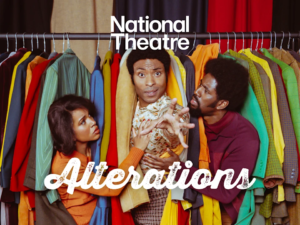
“Alterations” at the National Theatre By: Lauren Avila
Every choice just like any alteration in a person’s life can change it. To cut and hem time may cause a person to lose those which they love. Sew together the bonds that matter and a person can create a high quality product. Deciding which pattern to follow is the choice one must make, particularly when it comes down to an ultimatum. This is the emotional scale that is explored in the National Theatre’s current production of “Alterations.”

Soft, Caribbean melodies play in the background as patrons take their seats well before showtime. The sounds of traffic and bustling city life accompany it to create the atmosphere of the forthcoming story. Sirens whirring, cars honking, engines revving, and squealing wheels put the play in motion before it’s even begun.
The set, designed by Frankie Bradshaw, is singular, sitting upon a rotating platform. It is a tailor shop with a wall of clothing hanging about in the back. A few work tables fill the elevated, square stage. Every table provides a space to cut, sew, and repeat. A plush, burnt orange-colored chair sits in the corner, inviting any tired worker who is in need of the occasional tea break.
A full three minutes before showtime a man appears on stage, dressed in flare jeans, a paisley-patterned top (unbuttoned midway) and vintage brown leather jacket. He’s sporting aviator sunglasses and holding on top of his shoulders a retro radio. A cyclist circles the neighborhood as shoppers and others go about their business. They are not bothered and are simply enjoying their daily life.
Seamlessly the play begins…
Above the street, in a small tailor shop, Walker (Arinze Kene) is embarking on a timely task that will define his future. He has just accepted a commission for a large amount of trouser alterations. Mr. Nat (Colin Mace), a German immigrant, allows him the opportunity to do the task in a potentially life-changing deal. If Walker can fulfill the order in time, he will receive enough money to buy a tailor shop on Carnaby Street.

“Alterations,” directed for this adaptation by Lynette Linton, unfolds over the course of 24 hours, with each minute rising with intensity.
While Walker is working in the present he cannot stop thinking of the past and the future. His story is what stitches together the gap between the two. Not only is there a pressure to complete the challenge ahead of him, there is a dream at stake that consumes every part of his life. Still he allows himself to get distracted over and over in vignettes of his life, illuminated by Oliver Fenwick’s design.
Time plays a major role in “Alterations.” There is use of light and music to pass time, to create atmosphere, and to get into Walker’s headspace. Music is well-integrated into this production with help from sound designer, George Dennis, and composer, XANA. From the sounds of reggae or blues, to the bursts of music that shifts the mood of time-lapsing scenes.
In the shop, Walker relies on Buster (Gershwyn Eustache Junior) and Courtney (Raphel Famotibe). For this task he also employs another friend, Horace (Karl Collins). While all the characters in this production are suitably dressed for the 1970’s era of the play, none are as beautifully, albeit ostentatiously, dressed as Horace. Amongst his array of fashion choices is a purple, perfectly tailored suit by costume designer, Frankie Bradshaw.
Buster is a reliable business partner. He stays on task and avoids drama, regardless of the fact that his wife is in active labor throughout the play. He is waiting, much like Walker, for a new life to start. Courtney is a young local worker. He is ready to work and make his way up in the world. Horace is ambitious but keeps the balance between aspirations and priorities.
Darlene (Cherrelle Skeete) is Walker’s wife. They have come to London from Guyana, pursuing their individual dreams. Darlene is facing challenges of her own, having recently been fired. She needs support, both financially and emotionally, from Walker but he tends to come up short. He struggles to stay present as he chases his dream. As the play progresses, Darlene’s problems motivate the changes and decisions she feels she must make in order to achieve the dream she has formed for herself and her daughter.
Walker maintains distance. The dream is what matters. Friends and family are secondary to him. However, life is full of hard lessons that have to be learned. The play focuses on the price that comes with success.
Regardless of the profound themes of self-fulfillment and happiness, there is still a laugh to be had. Abbensetts’ play, with additional material from Trish Cooke, provides plenty of levity. The audience that sat in on a preview performance picked up every bit of humor sewn into the performance.
The production value is simple and avoids being overly flamboyant, neither visually or in sounds. There is just barely enough movement to keep the average audience member’s attention for the nearly two hour running time (without an interval). Unfortunately, one of the most engaging set and costume sequences comes down to only minutes. Additional platforms, costumes, music, and performers come together for a dream sequence that is as fleeting as a fashion trend.
Walker continues to want more throughout the play. More love. More business. More space. He wants more and is willing to live with less to have it. It would seem the National Theatre followed a similar pattern. There seemed to be a goal to add more to the retelling yet the creatives collaborated together to present less. If you prefer the less is more route and if you enjoy a straight-forward underdog story, go to see “Alterations” at the National Theatre. The show began previews 20 Feb, opened 27 Feb, and will play through 5 April.