
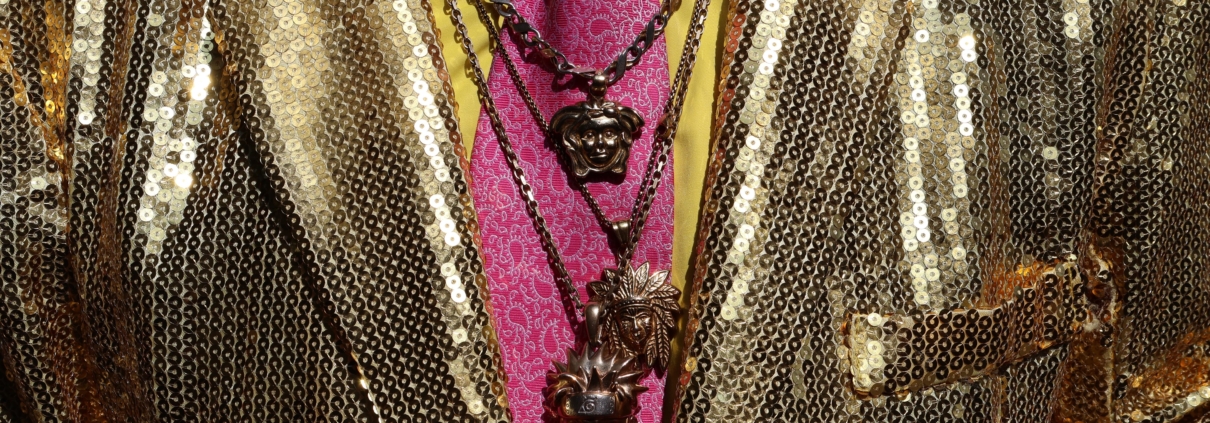
Meet the Man in the Colorful Suit: Jama Elmi
By Leah Gabriella Cardenas
A crowd has formed on Portobello Road and in the center is a man in a hot pink suit and matching hat. That man is Jama Elmi, 55, who has been donning vibrant outfits for the last seven years. Elmi currently works as a model and actor as well as an ambassador for the Rise Together Alliance.
He traded his once drab clothes for colorful suits when he was working at an Ibis Hotel. Elmi said, “They had their own uniform that was black and gray. I was invisible there, really invisible.”
But one day, he was on a long train ride when something caught his eye. “My eyes were craving color. I looked to my left, no color. Looked to my right, no color.” said Elmi, “Then, there was this advertisement of a man in a three piece suit. I said to myself ‘Oh my god, what does he have that I don’t?’ A suit. So I made it my mission to get a suit.”

Jama Elmi poses in a pink and gold outfit. Elmi said, “Four years ago, it used to take me an hour and a half to pick an outfit. But now, maybe about 40 seconds, 30 seconds.”
Elmi bought a suit and was quickly noticed by others when out on the street. He eventually went to Shepherd’s Bush to find a tailor after realizing his need for colorful pieces could not be found just anywhere. Every three months, he would return to get two new outfits made. Elmi thinks he now has over 800 different outfits.
However, with his tailor having switched businesses because of challenges from the COVID-19 lockdown, it’s been over a year since he’s gotten anything new. His 86 year old mother who he cares for has also given him an ultimatum. “If she sees a new outfit, I’m out of the door,” said Elmi.
This craving for color was nothing new for the Somalian. When he was nine years old, Elmi came across a mannequin wearing pink trousers and a Hawaiian shirt. He bought the outfit and wore it to school where he received a lot of attention from his peers. “I just loved color, but then that went to the back of my head and life came onboard,” said Elmi.
After rediscovering color in his clothing, people continued to be drawn to him. As he walks down the street, people in cars honk and wave. Seven years into wearing vibrant outfits, Elmi is known practically wherever he goes. But it’s not just the suits that make people smile, it’s also the conversation that Elmi welcomes.
Elmi said, “Even if they’re having a bad day, when I cross paths with somebody, I can see their face light up.” His fashion has even helped him in his work. When he was still a support worker, he’d pick his outfits each day for a different resident based on what they liked.
Not only does it put a smile on other people’s faces, but these interactions give the Harrow Road resident joy too. “It’s like that cartoon, Popeye. When he wants to be strong, he will have a spinach,” said Elmi. “The public is my spinach. The compliments they give me, that is my spinach.”
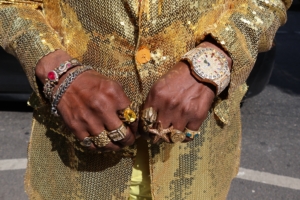
A close-up of Jama Elmi’s rings and bracelets for the day. “People come up to me and tell me stories,” said Elmi. “It depends on the outfit I’m wearing.”
One of his favorite suits has a map of the world on it. He loves the engagements he gets when wearing it. Elmi said, “When I went to Portobello, people were coming up to me and saying, ‘Oh, my God, I came from there’ and poking me.”
The 55 year old has begun conducting an “investigation” about his outfits and who they attract. “When I put on the red, it’s only the women that come up to me,” said Elmi. Pink surprisingly gets the attention of men, yellow attracts older folks, and young kids love his rainbow suit.
Elmi said he even once caught the attention of King Charles III. The then prince was apparently in a car trying hard not to let Elmi catch him staring at his vibrant suit. He had been sitting outside of a cafe on Queensway. Elmi recognized the royal just as the traffic light turned green and the car drove away.
However, not everyone starts out as a fan of the vibrant outfits. Elmi said that when he goes shopping for his mother, the Somali community would often tell him not to wear such clothing there. “Because religion wise, I’m not really a strict Muslim, but my mum is. So in Muslim culture, anything that attracts, it’s forbidden. But I love the center of attraction,” said Elmi.
Eventually, they’ve come around to embrace his flamboyant style. The kids go up to him now and ask him for pictures or to be involved in their projects. Elmi said, “I just tell them, just wear what makes you happy.”
Elmi has become a local celebrity over the last seven years. He is now featured in a photography exhibition at The Muse Gallery and is involved in the Notting Hill Carnival. But his goal continues to be spreading joy through his uniquely vibrant outfits.
Let Jama Elmi be a reminder that everyone could use a little more color in their life.


