Posts

12 Nights Together, Together: Harry Styles’ Record-breaking Wembley Residency

By Leah Gabriella Cardenas

Harry Styles released his fourth studio album Kiss All the Time, Disco Occasionally. on March 6, 2026. Leading up to that long-awaited release, the artist announced a residency tour called Together, Together. The tour includes 68 shows in seven different cities over the span of seven months. Styles began his run in London on June 12, the first of 12 total shows at Wembley Stadium.
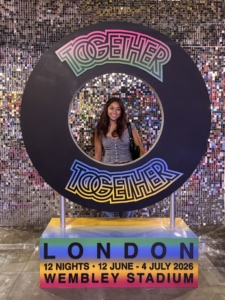
Also in London, was a pop-up store and fan experience presented by American Express. Located in Borough Yards, fans lined up to take pictures in front of different backdrops and buy exclusive merchandise. I went to the fan experience a few days before my show and only had to wait in line for about 20 minutes. I bought the pop-up store’s exclusive black London jersey.

I went to see Styles in concert on July 3rd, his second-to-last show in London. I purchased my tickets back in January when they initially went on sale, but I know that there were tickets being resold just days before the show. I took the Bakerloo and Metropolitan lines all the way to Wembley Park. Then, I still had to walk about 10 minutes to the stadium entrance.

Weeks before, I had seen videos online of people not being able to get inside the stadium because of the turnstiles. When we finally got to the front of the queue, I made sure the turnstiles were locked before scanning my tickets and trying to get in. It turned out to be no problem at all, but I was anxious about it the whole train ride over.
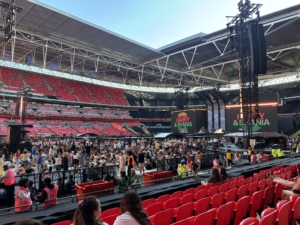
Once inside the stadium, it was easy to find our seats. We were in section 104 row 10. The view was amazing, though one of the screens was slightly blocked by a speaker and light stand. Still, we were closer to the extended stage than I thought we would be. It was definitely worth the price I paid as at times we got to see Styles really well and not just from the screens.

Shania Twain was the guest artist for London. She went on just before 7pm. Her set was about an hour long, packed with her classic hits. She even did a cover of Styles’ song, “Falling.” Twain’s energy and stage visuals got fans ready for a night full of dancing.

Styles has been known by fans for his thought out pre-show playlist. This time the last song was Simon & Garfunkel’s “Bridge Over Troubled Water” which inspired one of the songs on Styles’ newest album. Then, came the moment everyone in the stadium had been waiting for, Harry Styles ran out onto the stage.

I’ve seen Styles three times before this, twice during Love on Tour and once during his Los Angeles residency at the Kia Forum. I was interested in seeing the difference in his performance as it had been nearly three years since he was last on tour and four years since I had last seen him. 
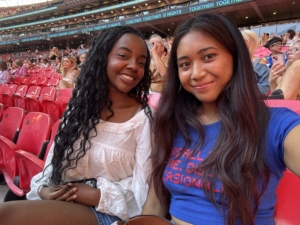
The artist started off with “Are You Listening Yet?”, an energetic song that perfectly set the show’s mood. Styles was wearing a navy suit, light yellow button-up, and hot pink tie looking like he came straight from a corporate job. Though the extended stage was massive and included two bridges, he quickly made his way around and then ditched his jacket.

Styles eventually brought out an orchestra to play “Coming Up Roses” and “Fine Line.” The latter used to be played at the end of his shows, but Styles said he was hoping it could signal a new beginning instead of the end to something. The shift in pace and mood felt necessary at this point in the night before the “Disco, Occasionally” vibe could continue with full energy.

Being in Wembley, Styles later recreated Freddie Mercury’s chant, telling the crowd to repeat after him. He then suddenly sang a few lyrics from a song off of his debut album, “Two Ghosts.” I nearly lost it when I recognized the lyrics, however, he just as suddenly left us hanging and moved on to a different song. I could tell that a lot of fans were feeling lots of different emotions after. 

As always, Styles also spent some time interacting with fans. That night, he spoke to two sisters who were dressed as disco balls, silver paint and all. He also spotted Sean McNicholas who does a Harry Styles tribute act. McNicholas’ sign asked Styles to take over his tribute shift, which the artist found amusing.
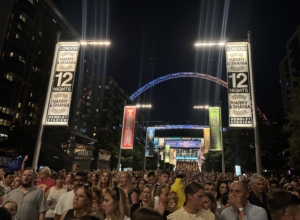
The night continued with the band moving into the middle of the stage for more danceable songs for which he was joined by dancers Aysia Ianiero and Rubia Serena Veth. Styles then seemingly wrapped up the show with the album opener, “Aperture.” He waved goodbye and expressed so much gratitude for his fans who allow him to keep doing what he loves.

Most of the audience, however, knew that the show was not over yet. Since the beginning of the tour, Styles has been starting his encore with a surprise song. Night 11 got “Boyfriends” from Harry’s House. This song was on repeat when I was sixteen and hearing it live again really took me back. However, I was hoping for something off of his debut album especially after the tease of “Two Ghosts.”

During his second to last song, “Sign of the Times”, a fireworks show lit up the sky above the stadium’s open roof. This was new to me at a Harry Styles show, but it truly added to the emotion of the song and night. Then before leaving the stage, Styles was visibly crying and taking it all in. After that 11th show, he had beaten the previous Wembley record of most consecutive sold out nights. It was truly an accomplishment worth celebrating.
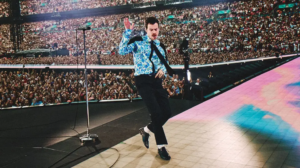
Photography by Anthony Pham

Compared to past shows, Styles’ outfits are more refined, his dancing remains energetic, and the care he has for his fans is evident. Harry Styles was born to perform. Even after taking a long break from the stage to reflect on his artistry, the 32 year old continues to rightfully sell out shows.
Humanity at Our Most Unsettling: An Interview with Folk Artist Frankie Archer

By George Clyde

A small canal runs through North Paddington, lined with colorful houseboats and street art on the walls of housing units nearby. It’s a scene that’s unique to this area, which is famous for its ethnic diversity, its history of social activism, and its ongoing relationship with the arts. On the night of Friday, June 7th, if somebody had been walking along the canal and strolled into St. Mary Magdalene church, now used as a venue for the arts called Grand Junction, they would have come upon a dimly lit folk performance, pulsing with the artistic vitality of the area. The night featured traditional folk music from Iran and the US, a solo performance of more modern original folk songs, and reinterpreted classics from the North of England, infused with electronic elements and sung by the headliner, Frankie Archer.

I had gotten a chance to interview Frankie earlier in the day during sound check. At the time she wore blue jeans and a white shirt from 1985 that showed support for miners from the gay community, and she had been cheerful and happy to chat about her music. But here on stage she was transformed.

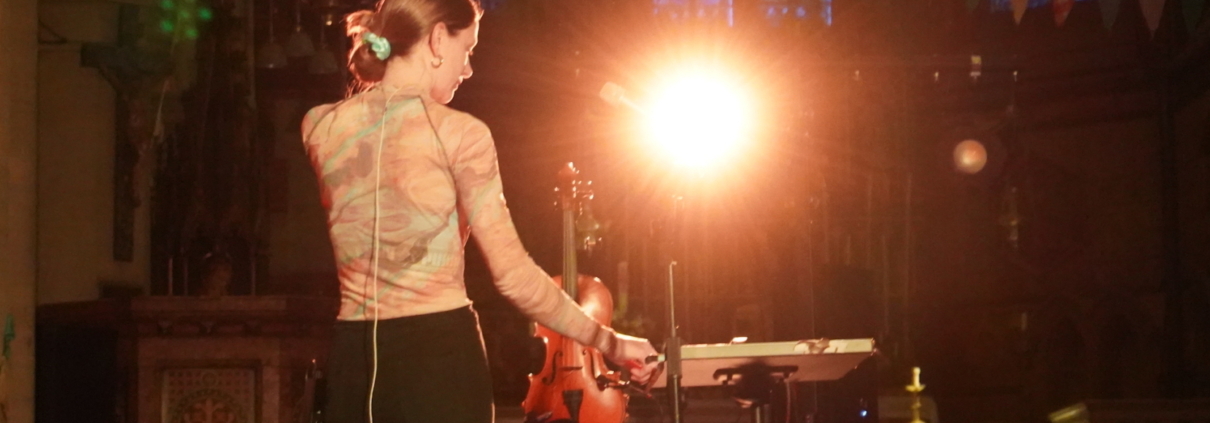
A golden stagelight illuminated her face; her arms waved gracefully as she looked into somewhere far beyond the crowd and sang these harrowing songs about murder, incest and rape. Clearly Frankie wasn’t crafting her music for commercial success, and this wasn’t the image of herself that she presented in her ordinary life. Some part of herself, deep beneath the person I talked to earlier, was out there on stage.

From a young age Frankie had been doing things her way. Her parents weren’t musical or artistic and she admitted that folk music was “a very uncool thing for a 12 year old to be into,” but to Frankie it just felt right.

“In school I had been taught to read the notes off the page. It was very strict. It wasn’t fun. But this was fun,” Frankie said, remembering her first introduction to folk music.. “There was so much energy in it.”

After many years of playing with a few bands at local pubs and working some jobs in between, Frankie finally made something that she felt was unique to her, so she put it out as her first single. “I was messing around doing everything. I was composing in some contemporary classical styles and then doing lots of Bulgarian influenced stuff and some like synth pop songs. I was doing everything really. And this was the one that just seemed like nobody else or like nothing else.”

The song is called Over the Border. It’s an old tune that Frankie added lyrics to about nature’s indifference to our man-made borders. The video features an interpretive dance along Hadrian’s wall in the north of England, where two lovers are separated by it before coming together.

The single seems fitting as an opening for Frankie’s career, which has carried the same disregard for borders and genres. Her tracks infuse all kinds of different electronic music elements. Throughout the performance at Grand Junction, she was constantly switching back and forth between looping electronic drum tracks and picking up her fiddle.

“I don’t work very consciously,” she said of her writing process. “I just sit down and then a thought comes into my head like, oh, you need to do this thing. You need to add this thing. So I do. And I really, really like that flow of building.”

For Frankie that flow state often seems to take her to some dark places. “I don’t sit down and process the emotions consciously. But obviously, like, this is something I really resonate with. So I think, I think it’s kind of very, very deep in us. And yeah, I think I do make connections with certain songs because of certain experiences, but I’m not digging into where they are. I don’t know exactly. It’s subconscious.”

Frankie pointed out, laughing a little at her own tendency towards these deeply disturbing tales, that she does have some playful tunes in her catalog. But she also compared these disturbing stories to things you might see in a gossip magazine. We all seem to have an often subconscious fascination with the hidden and twisted parts of our own nature.

Frankie’s interest in these songs comes in part from being able to empathize with the women in these stories. Her reinterpretations sometimes give more power to these victimized and helpless damsels. “A lot of songs do have women in their narratives. So, that, I resonate with, definitely when I’m choosing songs,” Frankie said. “In ways I’ve tried to say, like, these shit things, here they are. They’re in the traditional music canon and they’re still happening now.”

The song linked above is Oxford City, Frankie Archer’s most recent release about a girl whose drink is drugged. The lyrics are ancient, but Frankie added audio from a modern bar, signifying that the story remains just as relevant today.

Whatever Frankie might be singing about now or in the future, she has continued to do the things that feel right to her. She’s not interested in what’s going to sell or make people happy or even in fulfilling some bigger self-purpose. She does what excites her, and really, what else can someone do? When I asked her what she hopes for in her future, her answer was simple. “I would like to never get bored of making music,” she said. “I’d also like to make a living from it [laugh], I’ll get there. But yeah, I’d like to still get excited by ideas, no matter if I’ve been making music for 2 years or 50 years.”

An Intern’s Guide to Concert Photojournalism

By Carissa Leong, intern

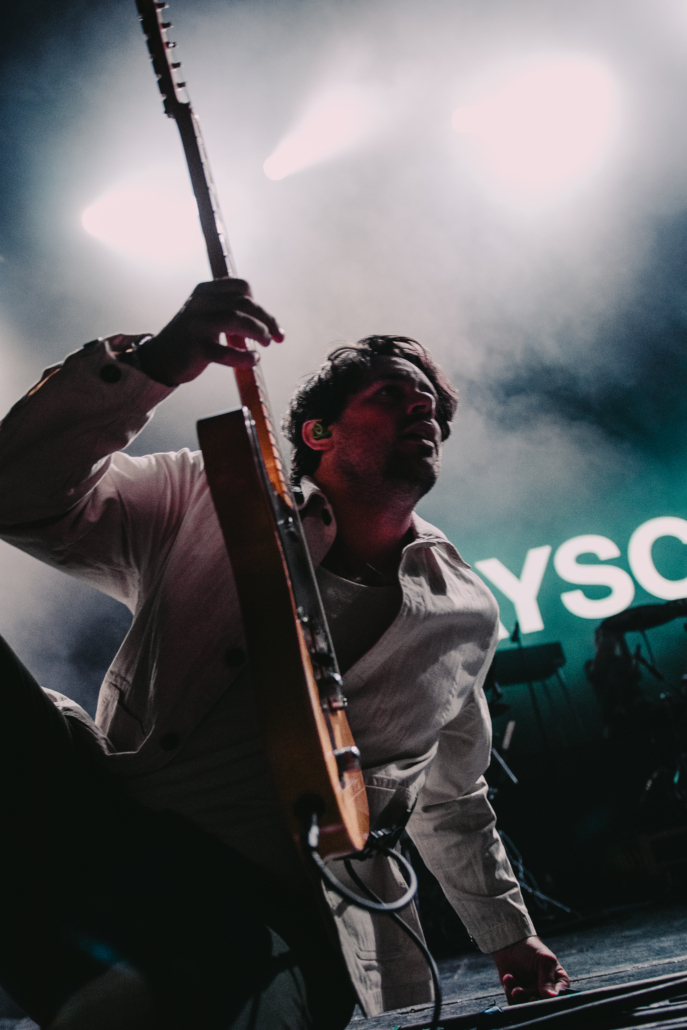
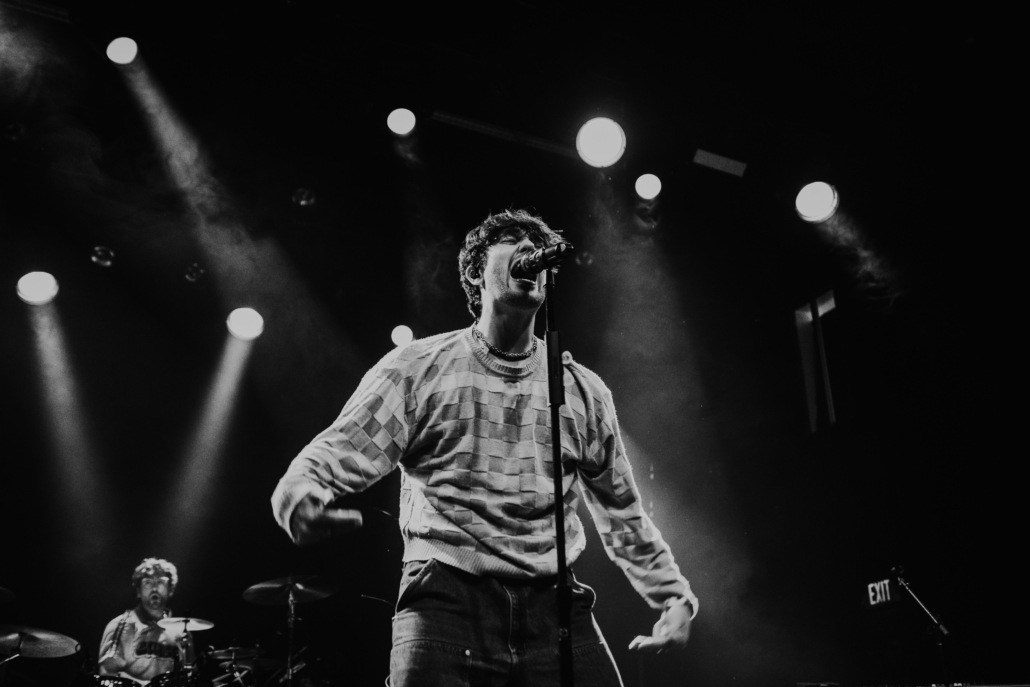
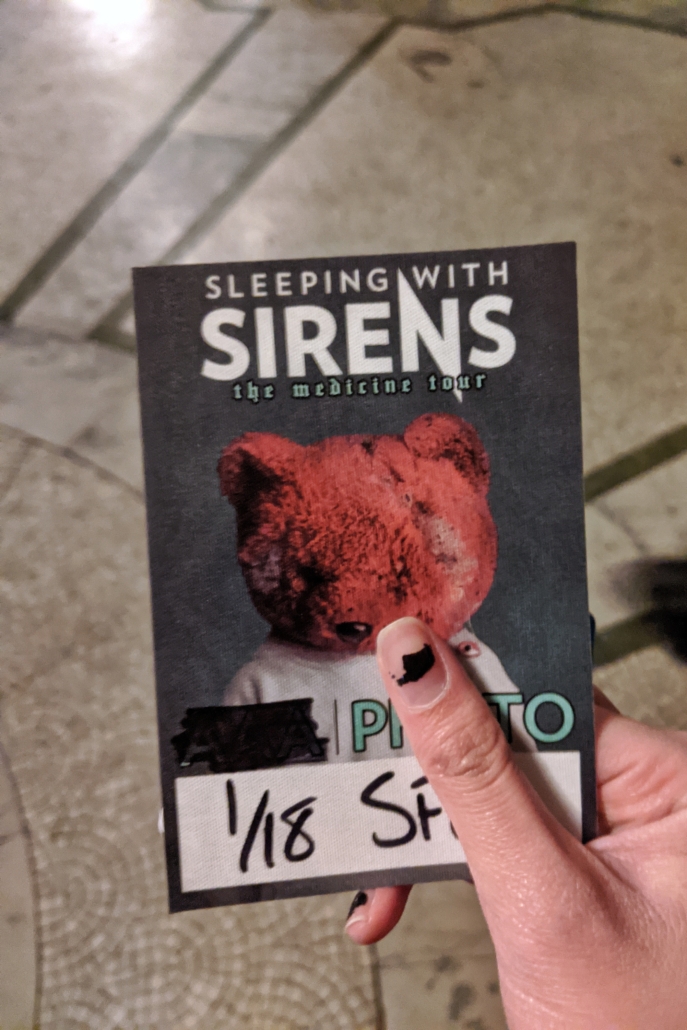
In high school, I was a big fan of music and a photography hobbyist, so the natural bridge was becoming involved in concert photography. At sixteen, I had my first press pass slipped into a laminate around my neck–covering the post-hardcore band Sleeping With Sirens at the Regency Ballroom in San Francisco, CA in January of 2020–and it was not only a long journey to get to that point, but also a long journey to continue from there. For anyone interested in pursuing the same hobby, here are a few tips.

Grayscale opening for All Time Low at the Wiltern, Los Angeles 11.10.23

Building your Portfolio:

  1. Reach out to small bands

If you don’t already have connections, a good way to start a portfolio is to reach out to local bands playing at venues that allow DSLR cameras. Typically for free entry, you can provide them with promotional photos that they can market themselves with while you receive the experience and work for your portfolio in return.

2. Low light

Keep in mind that you’re shooting in low light and need gear good enough to accommodate this. Make sure you shoot in RAW format to capture the greatest amount of detail and ensure that you can freeze the action with a higher shutter speed while still being able to see the subject. Look into owning a lens that can achieve a shallow aperture (f/1.4 to 2.8) as that will let in the most amount of light.

Half Alive at House of Blues, Anaheim 18.10.23

Getting onto a Publication:

  1. Apply

If you plan to photograph outside of Paddington Arts for any reason, there are a lot of small online music publications with application sections that are more prone to being open during the summer. Being backed by a publication is vital in getting approved for the higher-profile shows that you want. Often, you’ll be asked to submit your portfolio, a list of your gear, as well as your favorite musicians.

Christian French at the El Rey Theatre, Los Angeles 22.10.23

Applying for Press Passes:

  1. Editors

Stay in communication with your editor. If it is your editor’s job to apply for the shows that interest you, then don’t violate that unless you get permission and don’t be afraid to follow-up.

2. Review

You will also have a higher chance of getting approved for a show if you are able to write a review accompanying a gallery.

3. Be professional

If you’re the one directly communicating with the band’s PR contact, then be professional. Make sure they know your name, have access to your publication’s website as well as your portfolio, and ensure that they know what the press access will be used for. Don’t be afraid to follow up with these contacts as well, especially a week before the concert to remind them that you exist.

4. Use connections

Connections are everywhere. My alumna got me into the KIA Forum in Los Angeles to photograph an EDM artist San Holo with all-access–which was a surreal experience as I had just seen my favorite band Paramore performing at the same venue only a few months earlier–and my mother’s friend’s daughter got me access to her friend’s gig which was Devon Gabriella opening for Christian French at the El Rey Theatre in Los Angeles.

5. Transportation

Getting a photo pass will often come with free entry to the show, but keep in mind that you will still need to transport yourself which is a lot more difficult and expensive in car-dependent cities.

My first press pass 18.01.20

Shooting the Show:

  1. Be respectful

You will be let into a special area between the barricade and the stage called the photo pit. Make sure you don’t get in the way of the other photographers as much as possible. Don’t ever enable flash on your camera, as that can be very distracting to unexpecting performers and will result in you being kicked out.

2. First three songs

You will be limited to photographing the first three songs in the photo pit unless given special instruction so don’t fight to remain there after the allotted time. Afterwards, know the rules about shooting from the rest of the venue and what areas you would be allowed onto (ex. balcony). Don’t be afraid to check in with the security about the rules.

3. Camera settings

Shoot in manual mode and keep an eye on your light meter. The lighting will change unpredictably and depending on the genre, there can be rapid action so make sure there is enough light as well as a high enough shutter speed. Photograph in bursts to capture the best moments. From my experience, the most action–specifically in hardcore, punk, and metal genres–results in the best, most unexpected photos.

Geneva Jacuzzi opening for Automatic at the Fonda Theatre, Los Angeles 12.12.23

Coverage:

  1. Turnaround speedy but quality coverage

Submit 12-20 of your best photos to your editor. The ideal content turnaround timeline is 24-48 hrs from the concert, though bear in mind that your editor may be slow in going through the content that you sent over so don’t be afraid to follow-up. However, in the case that photos need to be approved before publishing, send a folder with the files to the artist manager first.

2. Send coverage to PR

If it was your personal responsibility to email the artist PR contact, then email them the coverage once it’s posted on the website to show that you are reliable enough to work with them again in the future.

3. Photo usage

Try not to post your photos from the show before it’s released by your publication unless you receive explicit permission to do so. Also don’t send your photos to another publication to use if you acquired a press pass through a different one.

4. Build your portfolio

If you end up getting good photos, make sure you update your portfolio!

JVNA opening for San Holo at the KIA Forum, Los Angeles 06.10.23

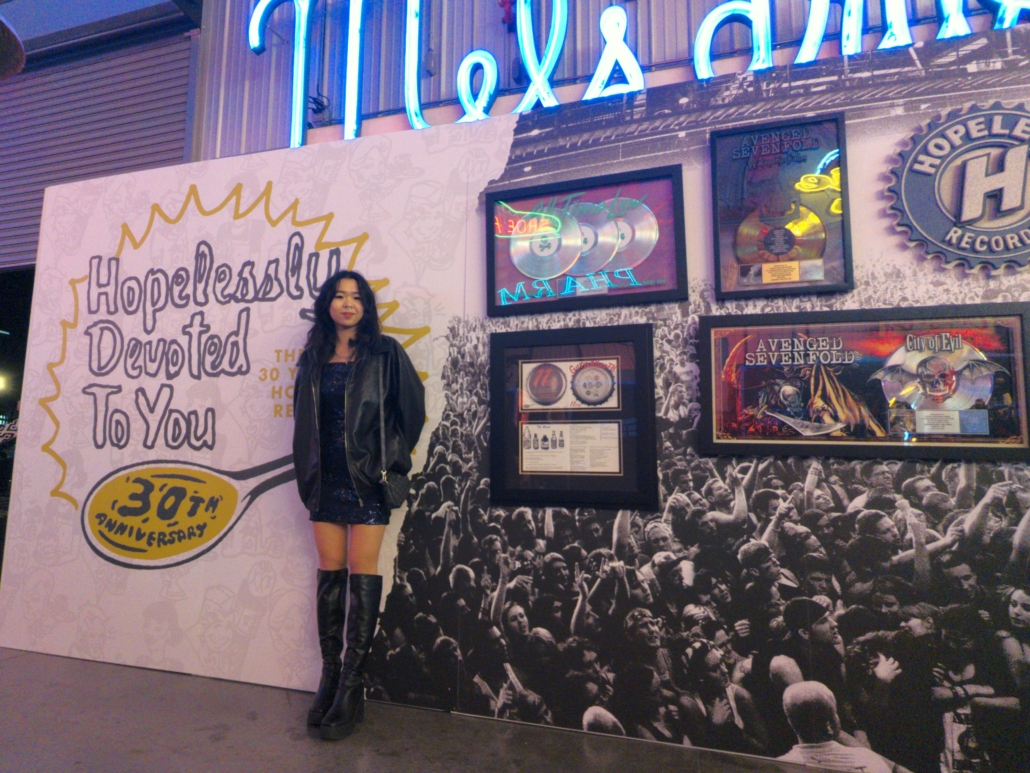
My early experience in this has led to my further interest in becoming a part of the music business, which admittedly arrived late due to the COVID-19 pandemic throwing off my career trajectory, yet it luckily still arrived regardless. A turning point for me was that through one of my publications, I was invited to the Hopeless Records’ 30th Anniversary museum opening party in December 2023 and had the opportunity to mingle with artists and creators in the industry that I had known about for years. In my future, I hope to become involved in record label marketing, starting out with internships in Los Angeles, CA where I am based, and it all started because I loved music too much as a teenager.

Me at the Hopeless Records 30th Anniversary Museum Opening 8.12.23

All photographs by Carissa Leong (@carissalphoto.cr2).

Show Review: Tom Odell at the Roundhouse, London

By Carissa Leong, intern

Thumbnail credit: Ciara McMullan (@ciaramcmullanmedia)

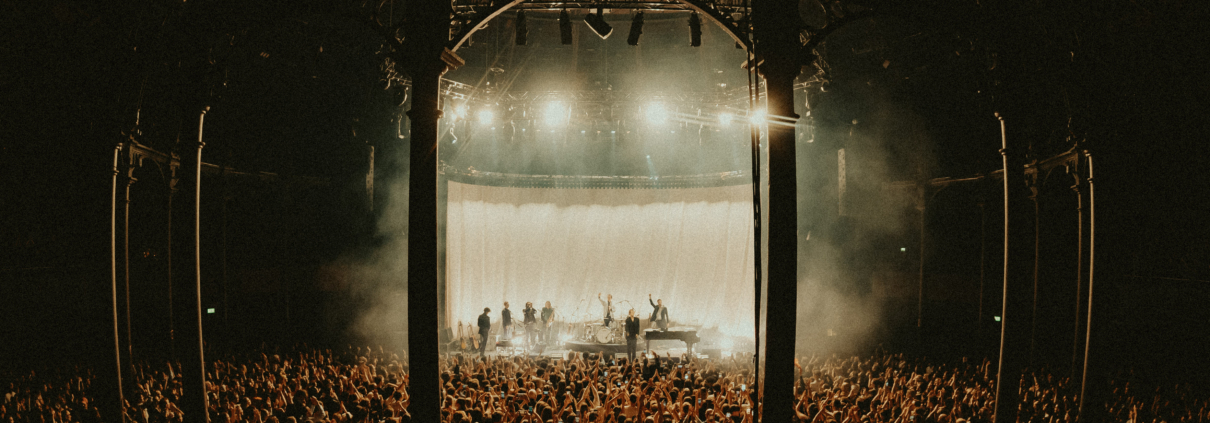
On March 15, Tom Odell had a victorious homecoming at the first of two sold-out shows at the Roundhouse in London while on tour for his newest album Black Friday. Accompanied by his backing band, his soulful vocals pulled the audience from triumphant highs to melancholic lows and back up again, multiple times over with apparent effortlessness.

To kick off the night, the sole opening act Sofia Isella was just nineteen but had the stage presence of a performer who had been in the industry for over a decade. Her performance was haunting and magnetic, successfully engaging the audience in ways that openers often fail to with a combination of breathy whispers, full-bodied vocals and casual chats. Taking advantage of her multi-instrumental background, Isella swayed in the spotlight while providing her own violin accompaniment to the last song on her setlist “I Looked the Future in the Eyes, It’s Mine.”

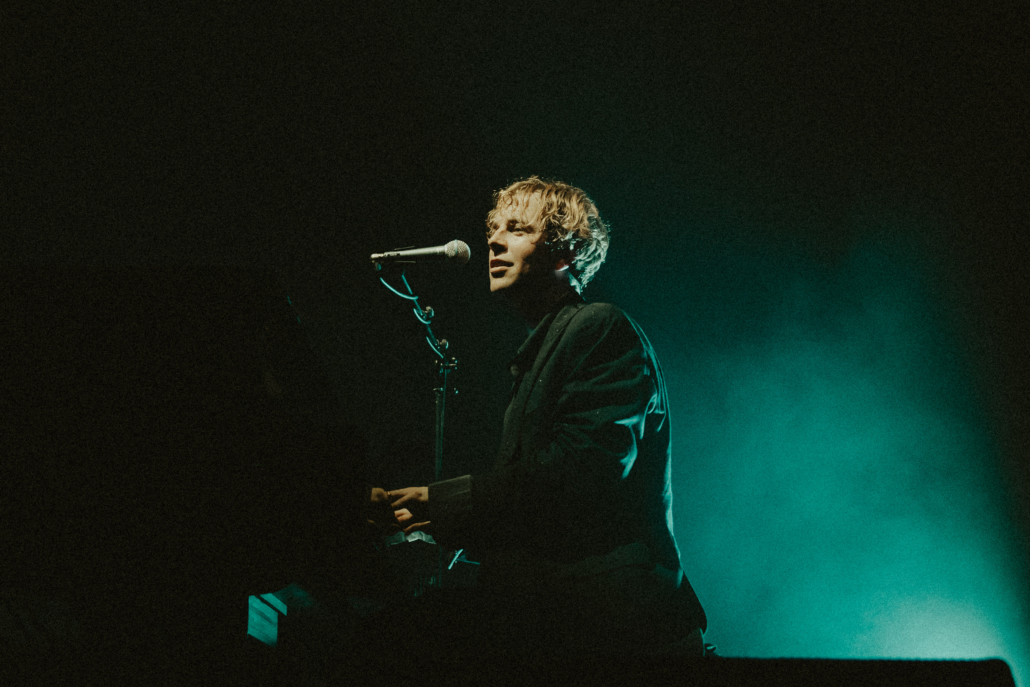
When Tom Odell finally took the stage, one of the most immediately striking characteristics was the show’s visuals. It reflected the cinematic simplicity prevalent in his album art and music videos, playing well with lighting, colors and shadows. From a spotlight carving him an isolated silhouette at his piano to his band’s shadows shifting across a piercing red backdrop, the lighting designers made the show visually engaging while staying true to Odell’s grounded, minimalist aesthetic.

Credit: Ciara McMullan (@ciaramcmullanmedia)

The moment that the first lyric rang through the air, a somber opening to “Somebody Else,” cheers immediately melted into a reverent silence at the raw emotionality of Odell’s live vocals thundering through the Roundhouse. The air of quiet awe was consistent with many of the ballads throughout the set. That was not to say that audience engagement was dissuaded at all, however, as many were happy to join their voices to the upbeat and popular songs. On the more spirited end, Odell directly employed crowd participation to call back parts of the anthemic track “Hold Me,” and there was a point where he amped the energy all the way up by clambering on top of his piano to sing.

Backdropping Odell’s vocal and piano performance was a whole host of different instruments, from the conventional guitar, bass and drums to the more classical violin, trumpet and saxophone that lent a jazzier edge less typical of indie rock singer-songwriters. The backing band contributed to layered compositions that made the emotional lows more heart-wrenching and emotional highs even more buoyant.

Credit: Ciara McMullan (@ciaramcmullanmedia)

Between songs, Odell included a love letter to the host city. Introducing “Long Way Down,” the title track from his 2013 album, he reminisced that it was the first song he wrote when he moved to London at around twenty years-old–over a decade ago, back when his present success was just hypothetical. He called out London as the best city which met an eruption of biased, infectious cheering.

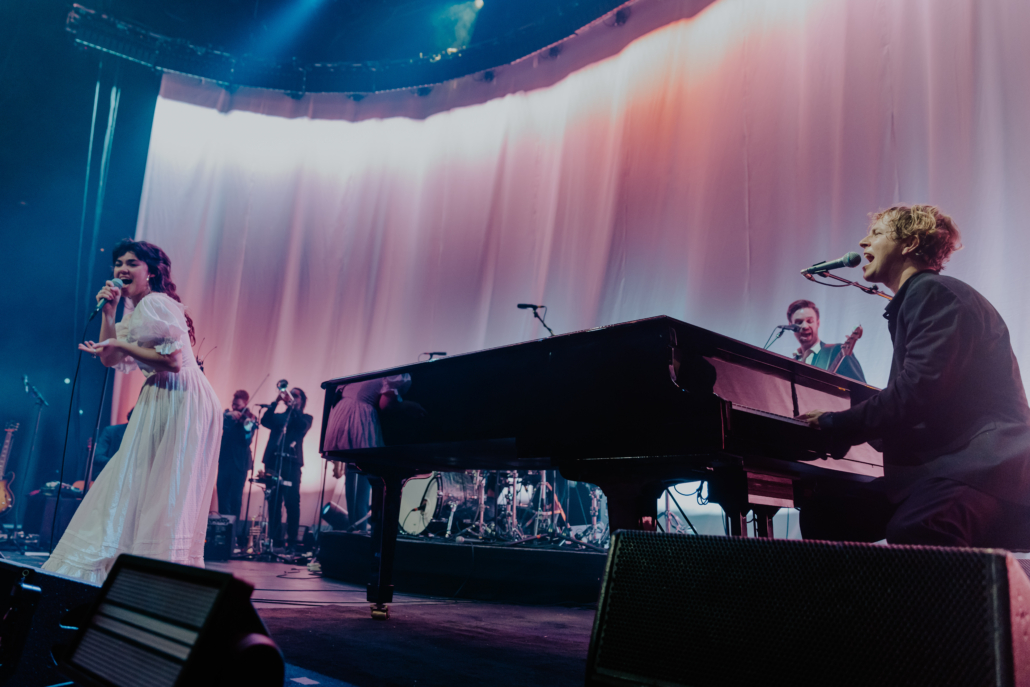
Further into the set, homage was also paid to Elton John whom Odell performed with in the past. For a nostalgic duet of “Tiny Dancer,” Abigail Morris, the singer of indie group The Last Dinner Party, was invited to the stage. It was well-received and many show-goers echoed the pair’s performance of the classic with their own attachment to the song.

Credit: Ciara McMullan (@ciaramcmullanmedia)

Tom Odell wrapped up the night with an ode to his expansive discography, leaving the audience with some of his newest music including the TikTok viral “Black Friday” but creating a final, bittersweet conclusion with 2013’s “Another Love,” his most popular song to date. A testament to the universality of his songwriting, I was one among hundreds who couldn’t help but relate to the utterly human topics confronted so artistically by the night’s performance.