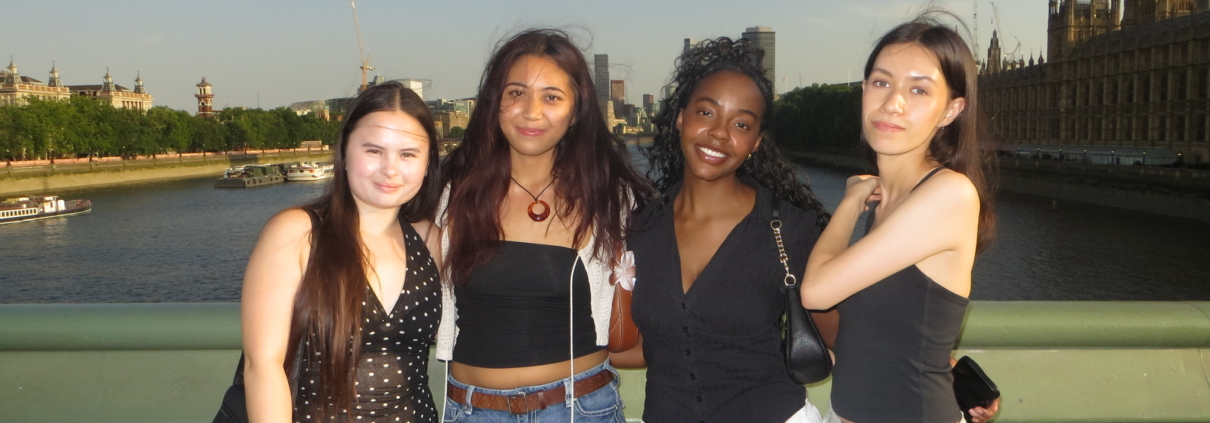
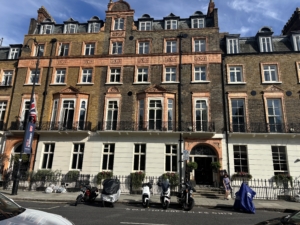
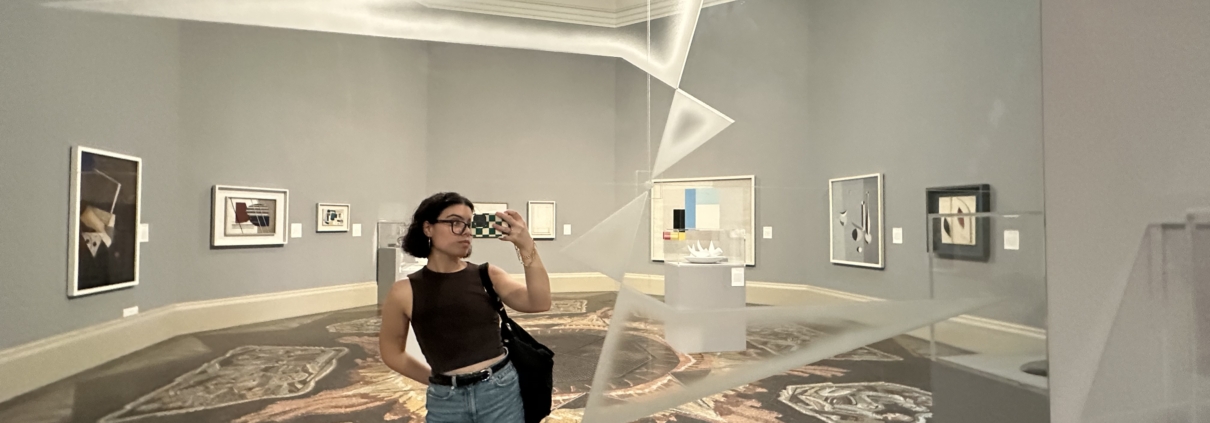
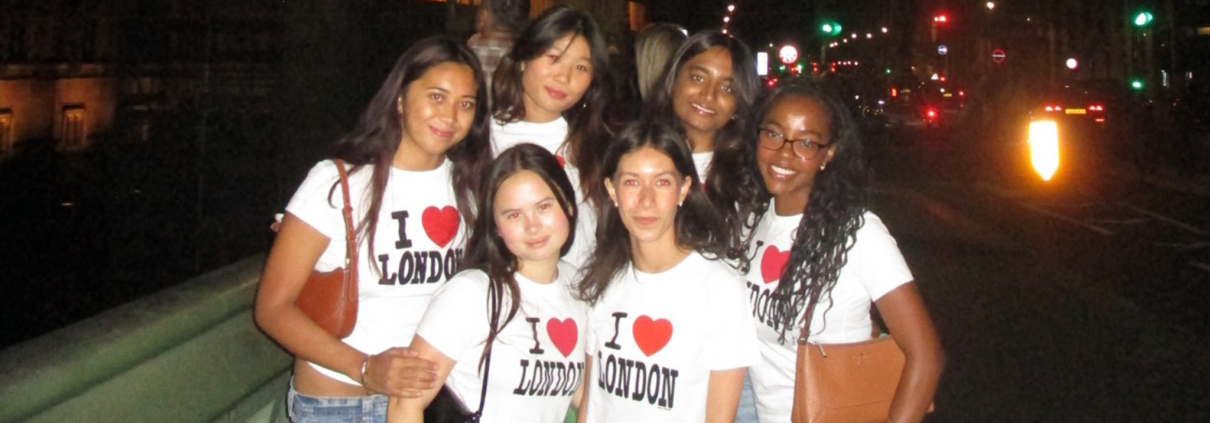
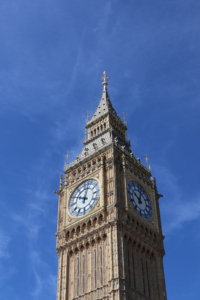
After eight weeks, my time in London and with Paddington Arts has come to an end.
Though I’m used to being away from home for weeks at a time, being in a different country and at first alone has been an entirely different experience. Especially considering that the last time I left the United States was when I was twelve years old.
I came to London with little expectations for this internship. I was mostly worried about fitting all the clothes I wanted to bring into just two suitcases. I knew I wanted to explore the city and travel outside of the United Kingdom a little but as for the rest of it, I was trying to be ready for anything.
After eight weeks, I feel that I have done so much more than I could have ever imagined. I learned a lot about London as well as who I am as a person and a writer.
I have been to eight new cities and three new countries. I have seen three West End shows, aballet, and a Shakespeare play at the Globe Theatre. I have met so many new people, some of which I see becoming lifelong friends.
This experience has challenged me. I put myself out there when meeting nearly 60 new people. I adjusted to living with five flatmates and just one tiny fridge. I learned to navigate the Tube to work without using my phone and somehow still had 20,000 steps every day. I also spent a lot of time exploring the city by myself. Being here has allowed me to do a lot of self-reflection and grow even more into who I am.
London has been very different from my life in Seattle or Los Angeles. I had never lived so close to the center of such a cosmopolitan city before which is part of the reason I chose to come here. I have now seen an entirely new side of the world.
While here, I have also written 13 articles including this one. Through Paddington Arts, I have learned about the city in a way I don’t think I would have working anywhere else. I often explored Notting Hill after work. I helped out one time at the nearby food bank run by Jacqui Haynes. I met and interviewed Jama Elmi, a local celebrity known for his colorful suits. I have explored different topics and writing styles, learning what other people like to read and what I’m good at.
Being a youth performing arts organization, Paddington Arts will always be a unique workplace for me, especially as a former dancer. As I continue to grow as a journalist, I hope that what I learned and practiced here will stick with me.
I’m glad I took this leap and decided to go abroad. I’m also immensely grateful to CIEE and Paddington Arts for giving me the opportunity to live and work here. London now has a special place in my heart. These last two months have been filled with memories and lessons I know I will never forget.
Thank you London.
https://www.paddingtonarts.org.uk/wp-content/uploads/2026/08/IMG_7364-2.jpg15812048paddingtonhttp://www.paddingtonarts.org.uk/wp-content/uploads/2022/01/Paddington-Arts-Fade-Logo.pngpaddington2026-08-07 15:12:392026-08-07 15:13:52A Love Letter to London: Reflecting on my Internship Experience
For as long as I can remember, I have always wanted to visit Paris. My tenth birthday party was Paris themed. In elementary school, I wore shirts with the Eiffel Tower on them all the time. I even had the 2015 American Girl Doll of the Year, Grace, who went to Paris in her story.
When planning weekend trips during my study abroad in London, I had to make sure that Paris was one of them. So this past weekend, I went to Paris with three of my friends. Here is what we did and what I would recommend.
My friend and I took the Eurostar early Saturday morning. It was just over two hours from London St. Pancras to Paris Gare du Nord. Once we arrived, we met with our other two friends and left our bags at a hotel as we couldn’t check into our Airbnb until later.
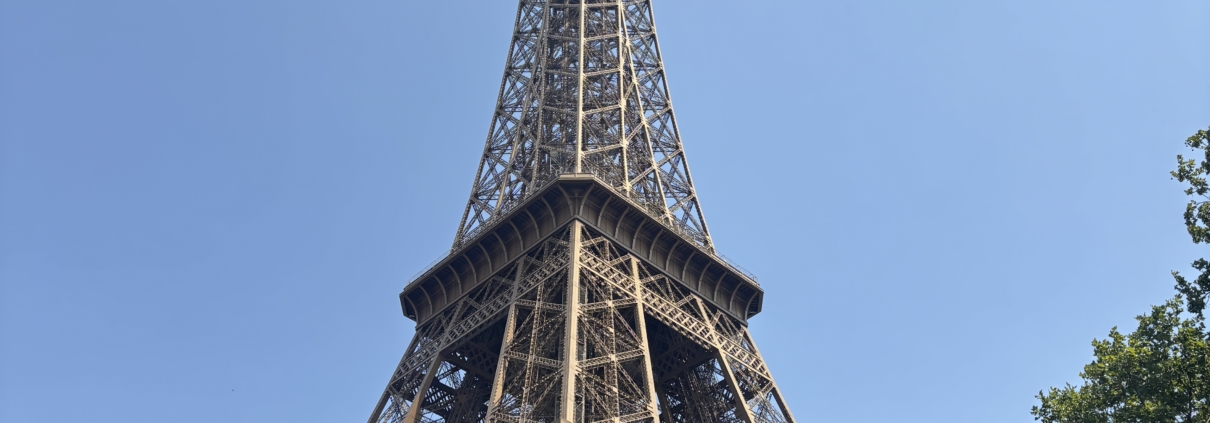
From there, we headed to lunch. We didn’t realize we’d get off the Metro right by a famous viewpoint of the Eiffel Tower, Place du Trocadéro. When the iconic landmark came into view, my friends and I visibly gasped. I even got a little emotional thinking about how ten-year-old me would have been sobbing had she gotten to see it herself.
After taking a few pictures, we headed towards the Arc de Triomphe. Along the way, we stopped for lunch at Le Kléber Brasserie. I had a croque monsieur which was better than I thought as they put an extra layer of crispy cheese on top. At the Arc de Triomphe we opted to just admire the outside rather than spending €22 to go inside as well.
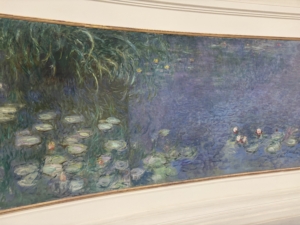
Then, we walked all the way to the Musée de l’Orangerie for Monet’s Water Lilies. We weren’t able to get tickets beforehand so we had to get in a longer line. We were told it would be almost an hour wait, however, it ended up being less than twenty minutes.
Tickets were only €11. Once inside, we went straight to the Monet rooms. The murals were even more impressive than I could have imagined. They were so huge and beautiful that I think I could have spent all day looking at them. This is definitely one of the museums in Paris that everyone should visit.
We then walked through the Tuileries Garden and towards the Louvre. We decided not to go inside because of the price (€79) and we were exhausted by then. However, I do hope to eventually go back to Paris and visit the Louvre.
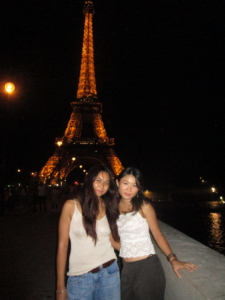
After a short rest at our Airbnb, we got dinner at La Casa di Alfio right by the Eiffel Tower. It was nice as the food came fast and we were able to sit outside. We made our way to the Eiffel Tower and somehow it looked even more impressive at night. We took pictures from on the Pont d’Iéna bridge and then waited for the tower to sparkle at 11pm. I’ve probably seen thousands of videos of the moment but it was even more magical in person.
We eventually headed to the Latin Quarter and tried to get into the famous underground jazz club, Caveau de la Huchette, that was featured in the 2016 film La La Land. We were told it would be a 45 minute wait to even be let in line which we’d then have to wait in for even longer. It was already past midnight so we opted for a much less crowded piano bar down the street. It ended up being a good last minute decision as we immediately got to sit comfortably and listen to live music.
The next day, we woke up bright and early to have breakfast at Cafe de Flore. The famous cafe known for its dark chocolat usually has a line, but we were able to sit right away. All four of us got a croissant. My three friends got dark chocolat with whipped cream while I had a coffee. The service was excellent and the hot chocolate was deliciously rich. I understand the hype now and would go again.
Then, we walked to Shakespeare and Company, a famous English-language bookstore. There are no pictures allowed inside the store so I kept taking mental ones for myself. The interior was eclectic and they have a wide selection of books. I, of course, had to pick up one of their tote bags. Just across the Seine was the Notre Dame Cathedral. We didn’t go inside because of the line, but we spent some time just admiring the outside.
We wanted to have a little picnic so we stopped by La Grande Epicerie to get a baguette, french butter, jam, and cheese. The four of us also got our own macaron. Then, we took the Metro to the Eiffel Tower and set our mini picnic up right next by the famous monument. I got to live out my “California” by Joni Mitchell moment by sitting in a park in Paris, France. Then, every few minutes I found myself looking up as if I couldn’t believe the Eiffel Tower was truly there.
The next morning, we had to be out of our Airbnb by 11am so we quickly packed and tidied up. After leaving our bags by the train station, we headed to Montmartre for some last minute souvenir shopping. We walked up the many steps toward the Sacré-Cœur Basilica. From the top, we had a gorgeous view of the city of Paris.
We walked around to shop and see the many live artists. I had to get a postcard and magnet for myself and my mom. We then stopped for lunch at Au Cadet de Gascogne. I had salmon and ratatouille. Now, I understand the Disney movie more as the dish truly is classic and homey.
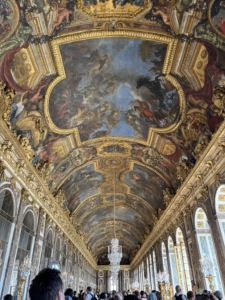
Soon, it was time to make the one hour trek to the Château de Versailles. Once we finally got there, we first visited the gardens before going inside. We of course saw the chapel and the Hall of Mirrors. One of my friends and I had to take the Eurostar back to London in just three hours, so we were rushing through the palace. I still felt that I got to see the major attractions as well as take in the gorgeous art and architecture.
It took us about an hour and a half to get back to Gare du Nord. I would have definitely bought our Palace of Versailles tickets earlier had I known that only the later, discounted time slots would be available and meant we would have to speed-run our visit. Luckily, our train ride back to London was smooth.
Here are some tips I’ve learned from this weekend. Our Airbnb was nice but it was located in the 19th arrondissement which was pretty far from the major tourist attractions. I would recommend staying somewhere more centrally located so you don’t have to spend as much time on the Metro. However, the Metro day passes are very worth it at only €12.30 per day. Coming from London, I also think the Eurostar is the way to go as it was convenient and fairly fast. You just have to pay a little more but it’s worth it. I’m glad we ended up going to the Palace of Versailles even though we rushed through it. It’s just a little outside of Paris full of beautiful art and history.
Now, I already miss Paris. The city definitely lived up to my childhood dreams if not having exceeded them. I do feel that I need to go again and for a longer period of time. We were able to squeeze in a good amount of sightseeing in just three days, but I know there is so much more to Paris. Still, ten-year-old Leah would be very proud.
https://www.paddingtonarts.org.uk/wp-content/uploads/2026/08/IMG_8670-scaled.jpg25601920paddingtonhttp://www.paddingtonarts.org.uk/wp-content/uploads/2022/01/Paddington-Arts-Fade-Logo.pngpaddington2026-08-07 15:07:202026-08-07 15:07:20Living Out My Childhood Dreams in Paris
After at least 10 hours of travel and being in an airport, about 60 college students from across the United States arrived in London where for the next eight weeks they would be living and working. Some had been to the United Kingdom before while for many, this was their first time. Either way, it would be quite the adjustment with navigating the Tube to work everyday or simply learning how to start the washing machine.
Spread out across five different living accommodations in Central and South London, communicating on WhatsApp and using Citymapper to get around quickly became the norm for the interns. The CIEE center in Russell Square was then their home base for weekly classes and events.
Melissa Nowacki in Notting Hill.
After just a week of London living, interns’ experiences and expectations going forward varied. “I’ve never really left the United States, so I’m excited to see the different cultures and all the tourist parts,” said Melissa Nowacki, a business law major at Arizona State University.
Nowacki is working with The Death Penalty Project as their communications intern. “Even things like spelling, I’ve struggled with here,” said Nowacki. “I’m typing things and sending them out at work and I don’t even think about how there are differences in something like a ‘z’ to an ‘s’ or double letters.”
Though faced with challenges, many students felt welcomed. Jaymi Robinson, a strategic communications major at Howard University in Washington D.C., is interning with Cavendish Consulting. “Everyone in the office is very friendly and also just understanding of the position of an intern who comes from America. They know we might feel a little disoriented and they want to help you,” said Robinson.
Jaymi Robinson in Kensington Gardens.
In addition to making workplace and cultural adjustments, having all new flatmates and classmates was difficult in itself. “I’ve been doing a lot of introspection, like thinking about my personality and hoping that how I’m being perceived by all these new people is good,” said Robinson. “And I haven’t felt that way since freshman year of college.”
Still, the interns quickly formed close groups to get dinner together after work or do some sightseeing on the weekends. “The first week was probably the most social week of my life, we were just out every night either at a pub to watch a [World Cup] game or just exploring like when we went to Primrose Hill,” said Brayden Brafford, a computer science student at Purdue University.
Going forward, some have even greater plans for their time in London. “I want to go to Amsterdam, Edinburgh, Ireland. I also want to see shows like I’m seeing Phantom of the Opera and I want to see The Odyssey in IMAX 70mm,” said Brafford. “There’s just so much to do in the city.”
The CIEE building in Russel Square.
Though some interns are used to living thousands of miles away from home or others have visited London before, working in a different country posed an entirely new challenge. From having an hour and a half commute to handling a heatwave without AC, the next few weeks will test the CIEE interns as they navigate being abroad. Still, most expect their time in London to be a unique and influential experience.
https://www.paddingtonarts.org.uk/wp-content/uploads/2026/07/IMG_3821.jpg15362048paddingtonhttp://www.paddingtonarts.org.uk/wp-content/uploads/2022/01/Paddington-Arts-Fade-Logo.pngpaddington2026-07-02 10:40:412026-07-31 11:33:07One Week In As a London CIEE Intern
One could only imagine all the things that could happen living in London for three months. There were times that I approached with wonder and curiosity, while there were those where I’d be lying if I said that I didn’t want to go home. However, those moments forever changed me, and I couldn’t be more grateful.
To quote Jake Keller, Paddington Art’s intern before me, “London broke my bank account…” I knew that was going to happen, but not in the first month and a half. To be honest, I got caught up in the shopping and going out to London’s pubs with my new friends. It was easy to forget that I was an international student on a visa, living in one of the world’s most expensive cities without permission to receive public funding. Then, reality hit. For a moment, I just wanted to go home to leave the discomfort behind. But I wasn’t going to let that define the rest of my time here, so I decided I needed to get creative and make the best of the situation. I cooked more of my meals, spent my days in awe of the free art museums, and wandered through Hyde Park in my new clothes — small things that brought me joy.
I’ve always been drawn to roles that support and uplift others, which is why I believe I was led to Paddington Arts—a not-for-profit that embodies those values and has made it its mission to empower youth through the arts. My role there was to write and post content for their blog, where I was given visionary freedom. That said, I had only ever written within a scholarly context, so this was a creative challenge. Initially, I was going to approach my articles by combining a journalistic and academic tone. That was more challenging than I anticipated, so I changed course and started writing about my interests, my reflections, and what was on my mind. These articles soon became another archive for my last six weeks here in London.
Looking back, my summer in London was far from perfect, but that’s what I needed. This was my first time living by myself and for myself. My mom told me that I wouldn’t be the same person when I came back home, and I know she’ll be right. Through every high, low, and quiet in-between, I’ve evolved more into who I’m meant to be. From navigating financial realities to finding my creative voice at Paddington Arts, each challenge shaped the experience into something I’ll carry with me long after leaving. And with that, London will always have a special place in my heart.
https://www.paddingtonarts.org.uk/wp-content/uploads/2025/08/IMG_1312-scaled.jpeg19202560paddingtonhttp://www.paddingtonarts.org.uk/wp-content/uploads/2022/01/Paddington-Arts-Fade-Logo.pngpaddington2025-08-08 14:01:342025-08-08 14:01:34The Summer I Left My Heart in London
From a star-studded cast flaunting futuristic fashion at premieres across the globe to reviews deeming it the best sci-fi spectacle seen for decades, millions could not help being drawn to the hype generated by the release of Denis Villeneuve’s Dune: Part Two, even trailing at the back-end of a five-month delay.
Dune: Part One, the film’s predecessor, released during my freshman year of college and I orchestrated a large group to view it in theaters at the time. Before that, I read the first three books and in high school, I presented on Villeneuve’s strong filmography from Incendies onwards. On top of all that, Frank Herbert’s Dune was rooted deep in my interests, a hero’s journey story that aged incredibly well–turning out to not actually be about a hero at all–and made for a piercingly relevant story about environmentalism, colonialism, and religious fanaticism. It was guided in adaptation by the precise, visionary hand of Villeneuve and Part Two culminated into a different take on the novel, ultimately worthy of the source material it represented.
In its prequel, stewardship of the planet Arrakis was given by the emperor to House Atreides, pulled from House Harkonnen’s control. Inhabited by the indigenous Fremen, the planet was also the source of the valuable substance spice. The transfer of ownership was a setup, and Paul’s father Leto sought to ally with the Fremen but died in a collaborative siege from House Harkonnen and the emperor’s Sardaukar. Meanwhile, Paul, wracked with visions of the future mounting in frequency, escaped into the desert and met up with the Fremen while accompanied by his mother Jessica, a Bene Gesserit sister harboring tools of manipulation. Historically, the sisterhood purposefully crossed bloodlines to breed a Kwisatz Haderach, a powerful man who could see into the future as well as the past, and it became believed that the Kwisatz Haderach was Paul–a generation too early and out of their control.
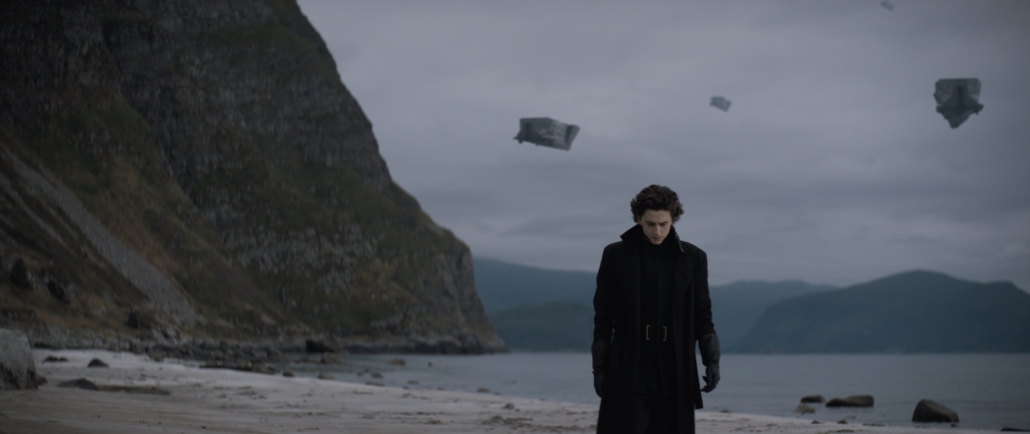
Credit: IMDb
Dune: Part Two kicks off with Paul learning the ways of the Fremen as his relationship blossoms with Chani, the girl in his visions. The Fremen take Jessica to be their Reverend Mother and her empathy drains away as her mind accesses generations of knowledge by ingesting the Water of Life. The process impacts her pregnancy and her coming daughter Alia is believed to be an abomination. Following the defeat of the Atreides, the Harkonnens reclaim control of spice production but are often disrupted by Fremen guerrilla tactics under Paul’s direction. Encouraged to go south and cement himself as a messiah among fanatic tribes, Paul resists because he foresees a holy war. Simultaneously, a threat from the Harkonnens grows in the form of the psychotic Feyd-Rautha. In order to survive and win, Paul travels south and fully becomes the Kwisatz Haderach, finally bringing about the holy war and bending the emperor to his will, to Chani’s immense disapproval.
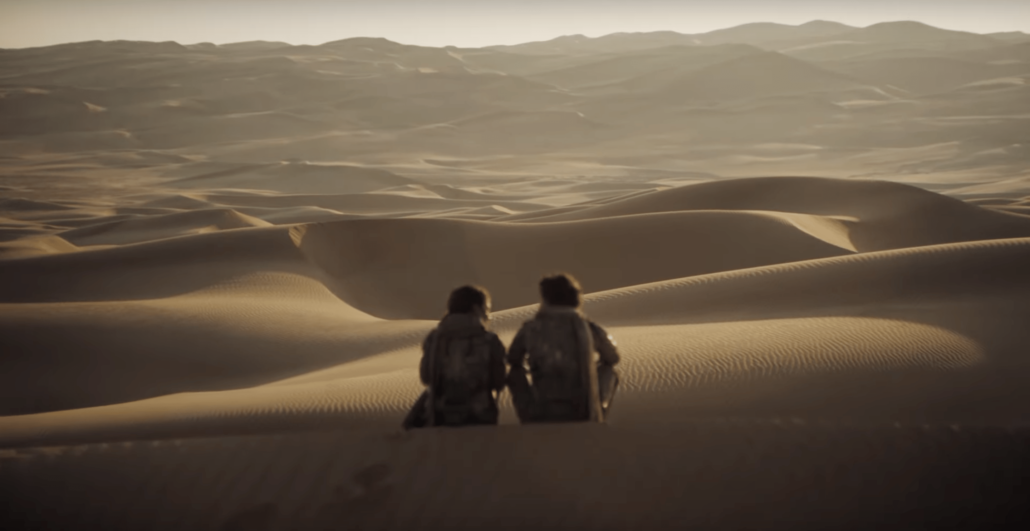
Credit: Cosmopolitan
Before viewing the film, a big aspect drawing personal skepticism was the two-part split. In retrospect, it turns out I had nothing to worry about. The time jump integrates well and fleshes out characters in a way that the novel lacked. Paul and Chani’s relationship development is more organic, and it’s emotionally investing to watch Chani’s trust in Paul fragment as he descends the path of his dark destiny. Similarly, it is intriguing to be closer to Paul in both good and bad–his victories while learning the ways of the Fremen and his struggles in the face of his bloodstained destiny. The context also benefits Jessica’s portrayal, and her transition from a mother caring for her son into the passionless, purposeful Reverend Mother is completely chilling.
Consistent with adaptation, Dune: Part Two is no stranger to differences from the source material. One of note is the presence of Paul’s sister Alia. Villeneuve saw the cheesiness in David Lynch’s 1984 adaptation, a toddler channelling generations of knowledge, and instead keeps her in the womb in telepathic communication with Jessica. The change contributes to Jessica’s eerie powers and the air of mystery benefits Alia, making viewers wonder what kind of abomination she would be when she’s finally born without having to directly portray it at all.
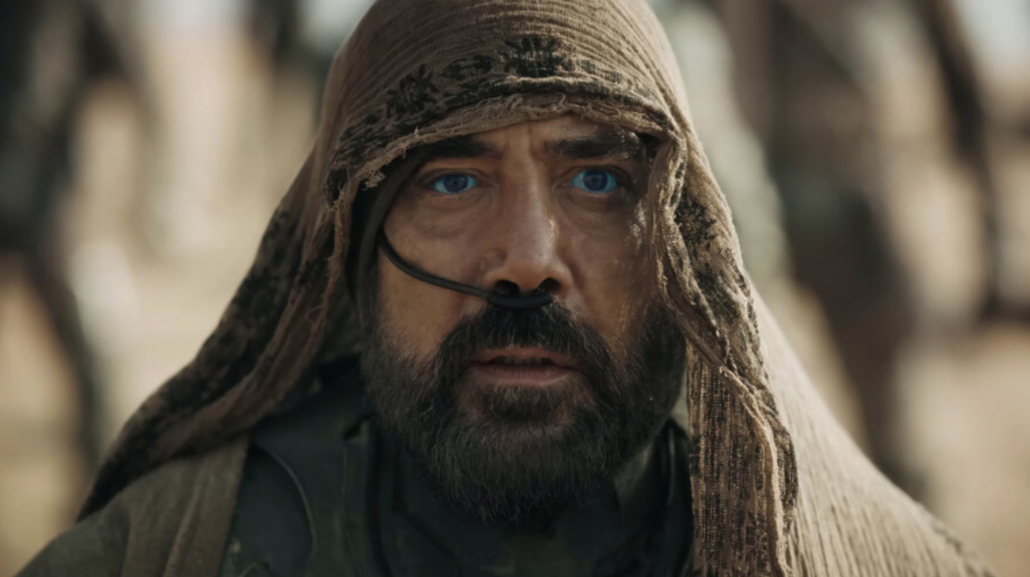
Credit: Radio Times
Another difference is the integration of Paul’s nemesis Feyd-Rautha halfway into this installment. There’s a lot of risk with a late introduction, especially regarding believability, but it is remarkably in-character for the cunning Feyd to exist in the shadows of his intense and fumbling brother, Rabban. It’s a little jarring to get his entire origin story in the middle of the film, a long sequence completely separate from the aesthetics of Arrakis, and I wonder if it had been viable to integrate him earlier while still maintaining his relevance.
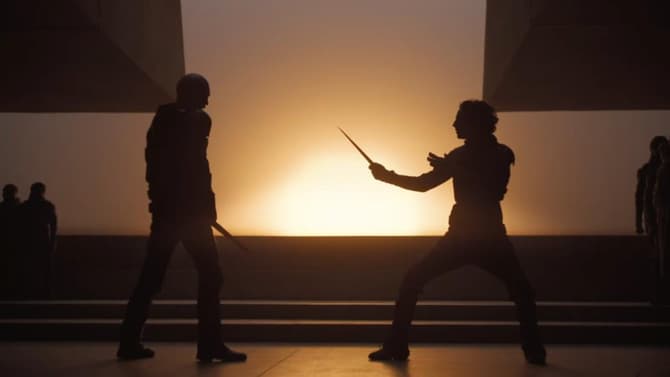
On the technical side, Dune: Part Two does a phenomenal job capturing both intimacy as well as scale, courtesy of constant collaborators Greig Fraser and Hans Zimmer. Over his past filmography, Villeneuve established and perfected an aesthetic of grand minimalism in science-fiction, particularly with the worlds of Blade Runner 2049 and Arrival, and the same purpose is evident in each shot of this film, from the massive arena under the black sun of Giedi Prime to the silhouettes of Paul and Chani on Arrakis, their gazes turned toward an ocean of sand. Zimmer’s sweeping score proves to be similarly versatile, backdropping raging wars to the softness of human connection, with everything catered to in between.
Credit: IMDb
Significant themes are explored throughout including a heavy critique of religious fanaticism. The prophecies that the Fremen believe in are faked, planted by the Bene Gesserit to ensure the safety of the Kwisatz Haderach and themselves everywhere, and it’s one of their many tools for manipulation. At first condoned, it’s taken advantage of by Paul and Jessica when they trade priorities–intimate relationships for colossal plots–as their minds expand into omniscience, drifting away from humanity. Because viewers are given more time to know the Fremen culture, we know exactly what’s at risk when they throw everything aside to worship Paul–specifically referencing the shot of burning corpses, a harsh contrast to the careful conservation of the bodies’ water at the beginning of the film.
On top of that, because of Paul’s inherited atomics as a Duke of one of the Great Houses in the Imperium, the means to officially overthrow oppressors would never have been in the hands of the Fremen originally. It would always require the loyalty of an outsider intermediary. It begs the question–could the Fremen have been given the resources that they lacked without the core of their people changing so completely or is the power dynamic between the privileged and underprivileged something that can never be fixed?
Credit: Escapist Magazine
As well, the link between colonialism and environmentalism is clear in Paul’s vision of his grown sister Alia walking in the future of Arrakis–dunes leading to an ocean. Contrasting the Fremen’s respectful co-existence with the environment, using the sandworms for transportation and echoing the sounds of nature in their walk, the colonists seek to change it to suit themselves and give it the ocean reminiscent of their homeworld. This is a vignette of history that has been repeated time and time again, with those harnessing the environment constantly prevailing over the indigenous communities that existed in-tune with it for centuries.
Ultimately, this is a film about warring familial pride and the lengths that one would go to preserve theirs, regardless of those caught between. In the film, Paul puts it well: to beat the Harkonnens, the Atreides must become them. The Atreides truly are no better, exploiting the Fremen for their own gains and genetically, they are exactly the same through Jessica’s bloodline. Even though he struggles with it at first, Paul’s decision is wholly selfish; he sees what he would become and opts for the dark path on account of the survival of his House and revenge for his father, rather than facing a moral death–even while knowing that his survival would barely give the Fremen more agency than the Harkonnens would.
Credit: Comic Book Movie
The ending with Chani alone, abandoning Paul and making her way back into the desert, poses as a cliffhanger alluding to the final act of the trilogy, the adaptation of Dune: Messiah. Chani is refreshingly given more agency to disagree with Paul’s decisions–which culminates when Paul chooses Princess Irulan’s hand in marriage for a political alliance, sentencing Chani to a future as a concubine, a harsh backhand since Paul originally stated his desire to be equal to her. It is interesting to consider how their relationship will be repaired in the time jump to Herbert’s second novel, and evidently, its portrayal will be in more than capable hands.
With a MAX show about the Bene Gesserit also in development, the franchise is already taking root as some of the most impactful on-screen science fiction in recent history. It epitomizes what the genre has always done best–create a speculative universe through which strikingly real flaws of society and humanity can be deliberated. More engaging than the prior installment, Dune: Part Two only furthers this mentality with every planted seed fully brought to fruition and resulting in the beginning of one of the most consistent cinematic universes yet.
https://www.paddingtonarts.org.uk/wp-content/uploads/2024/03/dune-part-two-17-new-trailer-stills_q92r.png6101267paddingtonhttp://www.paddingtonarts.org.uk/wp-content/uploads/2022/01/Paddington-Arts-Fade-Logo.pngpaddington2024-03-20 16:14:212024-03-20 16:22:13Dune: Part Two Analysis and Review
We use cookies on our website to give you the most relevant experience. By clicking “Accept All”, you consent to the use of ALL the cookies. See our Cookie Policy here
This website uses cookies to improve your experience while you navigate through the website. Out of these, the cookies that are categorized as necessary are stored on your browser as they are essential for the working of basic functionalities of the website. We also use third-party cookies that help us analyze and understand how you use this website. These cookies will be stored in your browser only with your consent. You also have the option to opt-out of these cookies. But opting out of some of these cookies may affect your browsing experience.
Necessary cookies are absolutely essential for the website to function properly. These cookies ensure basic functionalities and security features of the website, anonymously.
Cookie
Duration
Description
cookielawinfo-checkbox-analytics
11 months
This cookie is set by GDPR Cookie Consent plugin. The cookie is used to store the user consent for the cookies in the category "Analytics".
cookielawinfo-checkbox-functional
11 months
The cookie is set by GDPR cookie consent to record the user consent for the cookies in the category "Functional".
cookielawinfo-checkbox-necessary
11 months
This cookie is set by GDPR Cookie Consent plugin. The cookies is used to store the user consent for the cookies in the category "Necessary".
cookielawinfo-checkbox-others
11 months
This cookie is set by GDPR Cookie Consent plugin. The cookie is used to store the user consent for the cookies in the category "Other.
cookielawinfo-checkbox-performance
11 months
This cookie is set by GDPR Cookie Consent plugin. The cookie is used to store the user consent for the cookies in the category "Performance".
viewed_cookie_policy
11 months
The cookie is set by the GDPR Cookie Consent plugin and is used to store whether or not user has consented to the use of cookies. It does not store any personal data.
Functional cookies help to perform certain functionalities like sharing the content of the website on social media platforms, collect feedbacks, and other third-party features.
Performance cookies are used to understand and analyze the key performance indexes of the website which helps in delivering a better user experience for the visitors.
Analytical cookies are used to understand how visitors interact with the website. These cookies help provide information on metrics the number of visitors, bounce rate, traffic source, etc.
Advertisement cookies are used to provide visitors with relevant ads and marketing campaigns. These cookies track visitors across websites and collect information to provide customized ads.


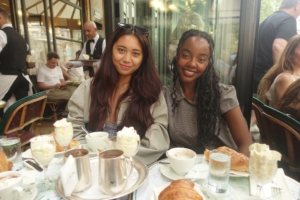 The next day, we woke up bright and early to have breakfast at Cafe de Flore. The famous cafe known for its dark chocolat usually has a line, but we were able to sit right away. All four of us got a croissant. My three friends got dark chocolat with whipped cream while I had a coffee. The service was excellent and the hot chocolate was deliciously rich. I understand the hype now and would go again.